A Sermon for the Nineteenth Sunday after Pentecost, Proper 24, October 20, 2019

A Sermon preached by The Rev. Beth Lind Foote, Interim Rector, on the Nineteenth Sunday after Pentecost, Proper 25, October 20, 2019

It is good to be back at All Saints’ after a weekend away in Santa Cruz with family and friends at the wedding of our son and now daughter-in-law. I returned with many photos, memories, and lots of bay laurel garlands from the table decorations. I brought some of the garlands here to the church this morning and they’re decorating the high altar.

I also brought back a huge sense of blessing and joy.  Scripture often uses wedding banquets as a metaphor for the reign of God, and that image ran through my mind last Saturday as our hearts were overflowing with joy.

Fortunately, as mother of the groom, I did not officiate at the wedding.  Our presider was a family friend, the Rector of Transfiguration, San Mateo. It was an outdoor wedding, but we put away our phones, prayed together, and as we witnessed the couple’s vows full of promises, love, and hope. And that is what stands out for me in our readings today, too, even in the parable of the unjust judge. Promises, love, and hope.

In our reading from Jeremiah, we hear God say, “the days are surely coming when I will make a new covenant with the house of Israel.” “I will put my law within them, and I will write it on their hearts, and I will be their God, and they shall be my people.” 

Even though God’s people let down God time after time, God promises to initiate a new covenant, and new relationship with God’s people  which, eventually, comes to us in the gift of Jesus Christ.

Our God is a God of promise, love, and hope, who reaches out to us and offers us grace through the gift of  Jesus Christ.

Our second reading is a letter to a congregation of early Christians.  Paul writes, “proclaim the message; be persistent whether the time is favorable or unfavorable; convince, rebuke, and encourage, with the utmost patience in teaching…do the work of an evangelist, carry out your ministry fully.”

This morning I hear Paul speaking to us at All Saints’ during our time of transition. I think it’s important to remember that we have a lot in common with the early Christians who lived before the thousand years of Christendom. The early Christians were swimming against the current of Roman life in which people worshiped a multitude of local gods and goddesses, as well as wealth. 

Paul encourages them, and he encourages us to persevere in our faith. His words speak to me today in the 21st century. How can we share our ministry and our community more fully with the world around us in 2019? Where do you see seeds of God’s work being planted at All Saints’?

In the parable of the unjust judge, the logic of the parable depends on a rhetorical device that’s called “lesser to greater” commonly used in the ancient world.  A paraphrase of verse 7 might be, “If an unjust judge can grant justice in response to badgering, how much more will God grant justice to those who cry out day and night? Jesus uses the unjust judge as a kind of cartoon figure to make the point that God is the opposite: God is the most just judge, who has infinite compassion for us.

The parable focusses on the widow’s persistence.  Widows were poor in Jesus’ world; and Jesus mentions them several times in the Gospels:  think of the widow’s mite, and when he raises a widow’s son back to life.  He has compassion for widows, and, I think, admires their persistence.

Luke writes that Jesus told this parable to the disciples to teach them about the need to pray always and not to lose heart.

I also think he’s teaching us about hope.  Hope is more than a wish or a dream.  I’m more and more convinced that hope takes persistence, and that God meets us in our struggle to be persistent.

In the Jeremiah reading God is persistent in initiating a new covenant with God’s people.  In the Timothy reading, Paul encourages the church to be persistent in their ministry.  These are both ribbons of hope that run through the scriptures, and our relationship with God. 

A persistent hope requires setting goals and planning for the future.  Our stewardship of the church today is a sign of persistent hope for the future of the parish.  Today, for example, we have the Diocesan Planned Giving officer here with us to talk about planned giving. From a parish financial perspective, we are fortunate to have an endowment and a rectory in the midst of the San Francisco economy. We can build on that strong foundation of hope with God’s help.

Yesterday, I realized that I started at All Saints’ the same week that our son and daughter-in-law became engaged. After all the spreadsheets and emails exchanged between our two families, wrangling with the guest list, the invitations were sent and then so many people came in from around the country. It took persistence and hope to put the wedding together.  There was a ceremony and a banquet, and we all witnessed a promise of love, and hope.

Here in our interim time, I have great hope in the future of All Saints’. The Good News is that Jesus persistently love us, and is here with us. He has set a banquet for us, and we are all his guests at the table.   Come, all are invited to the banquet celebrating God’s promise, love, and hope. 

Amen.
A Sermon for the Feast of St. Michael and All Angels, Healing Service, September 29, 2019

A Sermon preached by The Rev. Beth Lind Foote, Interim Rector, on the Feast of St. Michael and All Angels Healing Service, September 29, 2019

Several Octobers ago I slept overnight in Grace Cathedral. I went to the Women’s Dreamquest at Grace Cathedral with a friend.  It’s like a youth group lock-in for (mostly) middle aged women, and they’re almost all non-churchgoing women. It was spiritual not religious in many aspects. Founded by The Rev. Lauren Artress, Canon at Grace, who brought the Labyrinth to Grace in the 1990’s. I was intrigued to experience the cathedral from a different perspective.

After midnight the lights were dimmed, and people began to settle down for the night. I arranged my sleeping bag up in the choir where I was ordained a priest in 2008. At around 2:00 in the morning, I took a final labyrinth walk. I heard a buzzing sound from over on the side, and I went to investigate. It was coming from the modern art installation called Jacob’s Dream.

During the day there is enough ambient noise in the Cathedral that you don’t hear the buzzing light bulbs in the art installation. But after midnight it was quiet, and I sat and watched the flickering of shapes go up and down the fluorescent ladder, like footsteps.  And every few minutes you actually see a whole figure go up the ladder.  But you have to sit and study it to catch it, because it happens randomly, and like a good dream, it can disappear.  Try it sometime when you’re at Grace. 

That experience at Dreamquest came back to me this week as I was preparing to preach on our reading from Jacob’s dream of the ladder between heaven and earth.

Dreams are a window into our unconscious.  We barely remember them most of the time.  I’m sure that before smart phones, and electric light, people were more tuned into their dream life. Our brains were not going 90 mph all the time.

Jacob’s dream shows us a liminal space. The word liminal means an edge that shades into another space. Celtic spirituality would call it a Thin Space that opens between our regular life and the holy.

While Jacob watches the angels going up and down, the Lord stood beside Jacob and talks to him.  God renews God’s Covenant with the Hebrew people that God made with Abraham, Jacob’s grandfather. 

How does this beautiful story relate to us here at All Saints’ on the Feast of St. Michael and All Angels? Today is also known in the Anglican tradition as Michaelmas, and being close to the equinox, Michaelmas has traditionally been a celebration of the seasonal shift to autumn, that beautiful in between time between summer and winter. So Michaelmas itself is a liminal celebration.

It’s helpful to remember that our Interim time together is a liminal space.  And I am convinced that in this liminal space of the Interim time we can be open to a new dimension of the holy. 

Like Jacob, we are on a journey into the unknown. And God reaches out to Jacob in the midst of the unknown. That’s when God chooses to stand beside him in the dream.

When Jacob wakes up he says, “Surely the Lord is in this place—and I did not know it!”  And then he was afraid, and said, “How awesome is this place!  This is none other than the house of God, and this is the gate of heaven.”

I think most of us at All Saints’ would identify with Jacob’s statement; we know All Saints’ as a place of awe, a house of God, and the gate of heaven.  It has become that for us and for many before us.

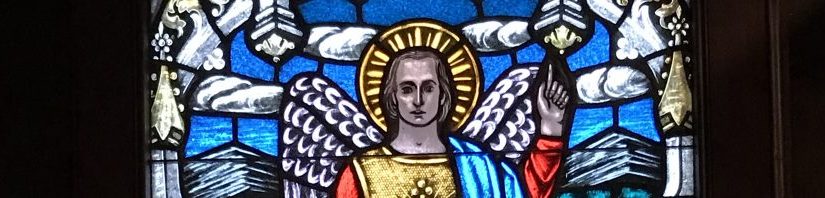
Our reading today from Revelation shows us Michael the Archangel and his phalanx of angels who fight the devil out of heaven.  St. Michael is one of the few archangels mentioned in Scripture, along with Gabriel, the archangel who came to Mary in the Annunciation.  We have both Michael and Gabriel represented in our stained glass windows.

Our insert today says “The Archangel Michael is the powerful angel of God who wards off evil from God’s people, and delivers peace to them at the end of life’s mortal struggle.”

St. Michael the archangel with his mighty sword became a protector for those who suffered and died of AIDS, here in San Francisco and elsewhere.  He was known as the “protector of the defenseless.”

In our garden, we have the Shrine to St. Michael in memory of all those in our parish who died of AIDS.  In Larry Holben’s book on the history of the parish, he includes a description by the artist, which I’m paraphrasing here, “In the void created by the cut-out of the angel, we see where the Archangel was present, has burned through into our space.  This spiritual presence is here to help us.”

That terrible and intense time of the AIDS Crisis is now 30+ years ago. Many of you were today were here, experienced it, and some of you have shared stories with me.  I remember talking with Kenneth about it when I was a student here 14 years ago, and with Sue Singer when I was at CDSP, too.

All Saints’ was a haven for these defenseless young men, like the place Jacob slept, “ a holy place, a house of God, and the gate of heaven.” All Saints’ reached out to them like God reached out to Jacob in his dream, and stood by them until they were taken up Jacob’s ladder to heaven. Our clergy at that time, Kenneth, Judith, and Sue, and the parish, were like angels to them, but they were mortals, not angels.  And there was a cost. I think its traumatic memory is burned into the soul of our parish like the image of St. Michael is burned through the metal in the shrine.

In the last 30 years there’s been research around the impact of trauma on people. Traumatic memories linger and can even be passed down through generations. They can continue to hurt us, and those who come after us long after the traumatic event.

One of the things that came out of our history days was a longing for healing.  I think it’s an important step for us to name it and address it.  Today we will have a Litany of Healing that offers up those traumatic memories, among other wounds of ours to God’s healing grace.

One of the things that I wonder as Interim is: how do we hold this important and tragic episode of our history going into the next phase of All Saints’? What is the role of our Shrine in the garden in the 21st century? 

I don’t know the answer to those questions, but they are important questions for us that I would like to engage more intentionally at a later date.  For one thing, the next Rector will probably in their 40’s which means they were born during the 1970’s or 1980’s. They will have no memory of the AIDS Crisis.  That is something to ponder as we go forward as well.

Today, I dedicate this Mass to those in our parish who died of AIDS, and to those who ministered to them with dedication, love and courage. The list of names of the dead as I have been able to find them will be on the altar as we celebrate the Holy Eucharist. 

Let us remember that we are a people of the Resurrection. When we gather around the altar to make Eucharist together, all our blessed dead are with us in that liminal space between heaven and earth as we break bread together in the Mass. Amen.

A Sermon for the Fifteenth Sunday after Pentecost, Proper 20, September 22, 2019

A Sermon preached by the Reverend Beth Lind Foote, Interim Rector, on the Fifteenth Sunday after Pentecost, Proper 20, September 22, 2019

What WAS that passage that we just heard? The Parable of the Dishonest Steward is a very strange Parable.  You may wonder, is it even a Parable? Why does Jesus make this crooked guy the hero of the story?

When Jesus tells us a story, we expect certain things to happen.  But this is one of those Parables where Jesus, the master storyteller, does something different.  He confuses us.

Confusion makes us stop in our tracks. Confusion can shift us out of auto-pilot and open our eyes to reality. So let’s look for a moment at the confusing Parable before us today. 

In Luke’s Gospel, The Parable of the Dishonest Steward comes shortly after the Prodigal Son, and I think the two stories play off of each other.  The Manager and the Prodigal Son are both untrustworthy. They have both been given wealth to manage and they both squander it. The Prodigal Son blows his inheritance on dissolute living.  The Dishonest Steward gets caught mismanaging the Rich man’s wealth.  And once they both  “hit bottom,” both of them are forced to pivot in some new direction to survive. 

The Prodigal Son has an internal dialogue saying he will work as a hired hand on his father’s farm, and turns towards home.  We hear the Dishonest Steward’s internal dialogue as well, “What will I do, now that my master is taking the position away from me?  I am not strong enough to dig, and I am ashamed to beg.  I have decided what to do so that, when I am dismissed as manager, people may welcome me into their homes.”  Both of them have the realization that life is deeply relational. 

They act upon that in different ways.  The Prodigal Son throws himself on his father’s mercy, and the story becomes all about reconciliation and forgiveness, and unconditional love.

The Dishonest Steward is more worldly, and the Parable reveals an uncomfortable truth about the way the world works. The economic system we live in has an enormous hold on all of us.  The Dishonest Steward knows that if he cuts the debts of the rich man’s debtors, they will take him in. He becomes a sort of Robin Hood rather than a bill collector.  The social contract is suddenly changed in his favor even though, to our eyes, it seems to make him even more dishonest.  The rich man applauds what he does.  Jesus’ listeners probably did, too.

In Jesus’ time there was enormous income inequality.  A few people were rich, like the steward’s boss, and it was way less than 1%, and most of the populace lived in desperate poverty.

That was the reality that Jesus’ listeners lived in.  It’s important for us to remember that as we hear the Gospel read in a 21st century context. They lived in a broken system and they knew it. People felt their own brokenness on a daily basis.

Ironically, in the Bay Area of 2019, with income equality becoming more extreme, we may understand the broken world of the Dishonest Steward more than we did in the past.

For most of my life, there was a belief in the American Dream and the promise of the middle class.  If you worked hard you could go to college, maybe own a home, and you certainly could rent somewhere to live. Our 20th Century economic assumptions gave us a sense of safety that has wasted away for many of us. As we’ve seen this week with the massive climate strikes around the world, people are concerned that the earth itself will survive.  This is the source of enormous unspoken anxiety in our lives.

I don’t want to depress you this morning, but our world is a broken world. We are broken human beings in a broken world.  Are you depressed yet?

Jake Owensby, the Bishop of Western Louisiana, writes a blog called, “Looking for God in messy places” on the lectionary readings. His approach to scripture is always illuminating and close to the bone.

Bishop Owensby writes about our passage today:

For centuries others have been shaping the world’s economies, political systems, social structures, and climate. Apparently, those people never considered consulting us, but we’re left to muddle through the world that they’ve left for us. It is what it is. What remains for us is, “So what are you willing to do?”

Observing the success, prestige, and comfort achieved by the world’s most cunning people, it can be tempting to be what some call realistic. To play the world’s game by the rules of the shadiest and most ruthless among us.

And yet, Jesus urges a different course. Don’t be naive, he says. Acknowledge how this world so often works. But don’t merely accept it. On the contrary, resist it. Resist it with love.

“It is what it is.”  There’s brokenness all around us, and within us. In our disposable society, we reject and throw away anything that is broken. We’ve forgotten that brokenness is an invitation to for mending, healing, and renewal. 

I like what Bishop Owensby says, “It is what it is.  What remains for us is, “So what are we willing to do about it?”

In this Parable Jesus acknowledges “It is what it is” and says God is even in that messy and anxiety ridden place that we inhabit on a daily basis.

Last Sunday we had our first history day of our interim time together.  We put ourselves on the timeline of All Saints’ history, and we had some good conversations at our tables.  We asked how you came to All Saints’ and what at All Saints’ has brought you joy.

Today we gather again after the 10:00 Mass for another history day.  If you weren’t here last Sunday I’d like you to put yourself on the timeline and address that question about what has brought you joy at All Saints’ with your table mates.

In the email newsletter I asked you all to bring a photo from the past to share.  If you brought a photo, I’d like you to share write down what it means to you and who was in the photo.  Then share it with your table mates and share what it means to you.  I’m going to come around and snap a digital photo of your photos and get prints made so we can put them on the timeline.

We have a rich history together here at All Saints’.  There’s joy, and also I’m aware that our history includes deep loss and brokenness. I wonder if some of you today feel safe enough in our loving community to share what that was like here at All Saints’? 

I’ve been wondering how that sense of loss has affected our parish?  Today I will prayerfully invite you to share some of that history of our brokenness. 

The Good News is that Christ has been here with us through all of it. Christ knows our deepest hurts and longings for healing. As we will here in our hymn today, there is a Balm in Gilead.  Amen.

A Sermon for the Fourteenth Sunday after Pentecost, Proper 19, September 15, 2019

A Sermon preached by The Rev. Beth Lind Foote, Interim Rector, on the Fourteenth Sunday after Pentecost, Proper 19, September 15, 2019

Recently, I went to Perry’s, the restaurant on Union Street, and I had a flashback.  Not a bad PTSD flashback, but a pleasant flashback. The walls of Perry’s are covered with posters from the presidential campaigns of old, and photos of people like John Kennedy and the Beatles, and famous San Franciscans like Joe Montana, Joe Alioto, and Joe DiMaggio. My flashback was to the 20th Century.  I realized that I felt very comfortable surrounded by all those familiar faces with so many associations. I am a “Mid-Century” baby, formed by the culture of the late 20th Century.

Our history at All Saints’ is also deeply rooted in the 20th century.

Today and next Sunday we’ll gather after Mass to spend some time in the 20th Century to talk with each other about our history.

Since All Saints’ hasn’t had an Interim in 30 years, you may have never participated in a history day before.  History days are a standard part of the Interim time when we get together and talk with each other and gather some information about where we’ve been, and also share memories with each other.  Some of that information will be captured so that when we get to the Search Process, we’ll have narrative data to work with. Because we have a rich history, we’re going to have two history days.  And we may have more discussions down the line.

At today’s meeting we’ll look at the big picture.  We’re going to place ourselves on a giant timeline, and have some small group table discussion.  

Next Sunday we will spend more focused time in small group discussion talking about the last 50 years. I hope that you can stay for a light lunch and discussion for about an hour today and next Sunday. It will be interactive and fun.  Don’t worry, I’m going to give you specific instructions.

Today’s readings both tell us something about the history of God’s relationship with us.  One ends on a wrathful note, and the Gospel ends on a joyful note.  What do they teach us about the nature of God, and who God wants us to be?

In Jeremiah we hear about God’s anger with God’s people.  “The whole land shall be a desolation; yet I will not make a full end…for I have spoken, I have purpose; I have not relented nor will I turn back.”  Jeremiah grieves, and is shocked by the prophecies YHWH presents to him.

Contemporary commentators say that Jeremiah spoke of a shift from the original Covenant of Moses to a covenant based on a new paradigm.  The existing worldview had to collapse before a new one could be constructed, which sounds strangely familiar given current events these days.

This passage spoke to me in its desolation of the earth. Today, the earth is hurting from our wasteful way of life. We need a new paradigm for the earth to survive.

Last week Greta Thunberg, the 16 year old Swedish climate activist sailed across the Atlantic for a U.N. conference to avoid the carbon footprint involved in flying. I have great hope in the younger generation of activists like Greta who are standing up and saying this is a crisis, our house is on fire.  The Parkland students are in the same new wave of activists who are saying enough is enough.  A new paradigm is fighting to be constructed.  They have a righteous anger, much like God’s righteous anger in Jeremiah.

In our reading from Luke Jesus tells us two familiar parables:  the Lost Sheep and the Lost Coin.  What do they tell us about God’s covenant relationship with us?

I love how Jesus starts off with “which of you does not?”  In fact, I bet not many of us would leave 99 of our sheep to find the 1 who wandered off.  Especially in our time of late capitalism, the loss of 1 sheep would be written off as a business loss, and expected as a cost of doing business.  If you left the herd unsupervised while you went on a search, the rest of the herd might wander off.  Part of the surprising nature of Jesus’ parables is in these unlikely twists.  He calls us to a look at things differently.

In the Parable of the Lost Coin Jesus shows us a woman with ten coins (which was a lot of $) who searches just as diligently for the lost coin as the shepherd does for his lost sheep. She does a clean sweep of her house under expensive lamp light to find it.  What does this mean?

These parables show us a different kind of relationship with God than in the Old Testament. They show us the same God, but the Gospels show us God in a new way.  God is loving and seeks us out, and never gives up looking for us.  And when God finds us, God calls together the angels and they rejoice together.

Notice the joy in both parables.  There’s the joy of finding the lost sheep, and the lost coin.  And there’s the joy of gathering together and celebrating in community.  Each sheep has value and is treasured; this idea of inherent value is even more pronounced in the story of the lost coin. 

Today at our gathering after church one of the things I want you to think about is: How did God bring you to All Saints’?  And, where do you find joy at All Saints’?

On Friday and Saturday I attended a Diocesan training called “Healing Racism.” I learned a lot. 

One of the activities was a Lection Divina session on our Gospel passage today.  The passage really spoke to us as a group about the idea of inclusion.  For me, If God is always seeking us out, God is also modeling a way of being in the world. We need to seek out those who are lost or hidden from our sight. In light of the healing racism training, we asked, who is missing from our flock? 

I don’t think it means “saving” people as much as being in relationship with people. Saving is about power, and welcoming is about intimacy. Saving is primarily about individuals, welcoming is primarily about community. I wonder what that would look like here at All Saints?

As we move farther into the 21st Century, we’ve entered a challenging time for the Episcopal Church as a whole.  We are increasingly older and whiter than the neighborhoods around us.

The commentator G. Penny Nixon writes, “True repentance happens when our minds are changed to such a degree that we cannot see a community as whole until all are included and none are “lost.”  This is 21st century work for parishes all over the country right now.  It resonates with our ministry context at All Saints’.  The Good News is that we are not alone, and that Christ is there leading us into a more inclusive way of being.

What stands out for me in the passage is the joy that comes from finding the lost sheep and the lost coin. There is “Joy in the presence of the angels over one sinner who repents.”  It sounds like it’s definitely worth the search, worth the work of repentance, worth the work of our interim time together.  Amen.

A Sermon for the Twelfth Sunday after Pentecost, Proper 17, September 1, 2019

A Sermon preached by The Rev. Beth Lind Foote, Interim Rector on the Twelfth Sunday after Pentecost, Proper 17, September 1, 2019

It’s wedding season for my family. Our children are in their late 20’s early 30’s, and so are their friends. Last weekend went to a family friends’ wedding at St. Dorothy’s Rest, and we are now on the countdown to our son’s wedding in October.  Some of the preparation has been fun, like tasting10 flavors of gourmet cupcakes, and some of it has been challenging, like the decisions around the guest list. All of these social decisions reminded me of our readings this week, and made me ponder the many kinds of hospitality.

Most common in our society is “the hospitality industry,” a transactional kind of hospitality.  We make a reservation at a restaurant or a hotel. We show up on time, we pay our money.  It’s kind of neutral in tone. But it’s important to remember that it wasn’t so long ago that “the hospitality industry” discriminated against people of color.  This kind of hospitality is not so neutral after all.

Private events offer another kind of hospitality.  Jesus talks about this kind of hospitality a lot because basically there was no hospitality industry in his time. And so, the image of the Banquet figures large in scripture.  Consider the Wedding at Cana, the gatherings at Mary and Martha’s house, and his meals with the Pharisee’s, like in today’s reading. 

What is Jesus trying to teach us this morning about hospitality?

Whenever we enter a social event, we ask ourselves “where do I fit in?  Where do I sit?” which is why seating charts are so popular.   Jesus knows that some people jockey for the best seat, and want to see and be seen close to the host. But they also don’t want to be shamed and demoted.  Jesus offers some basic lessons in manners:  Sit towards the back and you might get upgraded.  He suggests humility.

What makes this passage a parable is Jesus’ turning common sense advice into a theological teaching.  He says, “For all who exalt themselves will be humbled, and those who humble themselves will be exalted.”  Jesus shows us how God evens out social status.

Whatever our social position in human society, God looks at us with eyes of love.  In God’s eyes, we are all the same social status, we are all loved as God’s own.  At God’s table we are all at the “head table” next to the host.  When we see through the eyes of Jesus, the guest lists and social hierarchies melt away to reveal holy hospitality for all.

Jesus knows how hard it is to offer holy hospitality in the real world.  And so he challenges his host.  He tells them: don’t invite the usual crowd, expecting reciprocation within your own social circle.  But expand the circle to include even the most vulnerable. He says, ”you will be blessed because they cannot repay you, for you will be repaid at the resurrection of the righteous.”

Jesus says true hospitality is not about expecting payment, or reciprocity, but extending God’s love out to all.  That is holy hospitality.

In our reading from Hebrews this morning we hear Paul say, “Let mutual love continue.  Do not neglect to show hospitality to strangers, for by doing that some have entertained angels without knowing it.”  This is another example of holy hospitality.

Long ago, I had a memorable experience of receiving Holy Hospitality. I was 19, and my college roommate and I were traveling by train through Europe the summer of our sophomore year. We stopped in Canterbury, England for the day, and left our backpacks in the “left luggage” area in the railway station while we went sightseeing.  When we went back to retrieve them, the station locked.  It was closed for the night. We had nowhere to stay, and as it got dark, we began to knock on the doors of hotels and bed and breakfasts.  It was high tourist season.  Everyplace was full.  Just as we were about to panic, an innkeeper invited us in.  He said we could sleep in the living room if we set all the tables for breakfast the next day.  He would not accept our money; he only asked us to share the favor to someone else in the future.  To me, he was an angel of hospitality, and I will never forget him.  Over the years, I’ve tried to practice holy hospitality, too.

Here in the church, we’re called to offer holy hospitality, and to offer a community of God’s love on earth.  It is not always easy because it stands in tension with our social training and the society around us.

I think it comes down to baking hospitality into our Sunday morning routine. Ushers and greeters are important ministries because they offer holy hospitality.  How do people know where to sit? We need to make it less threatening to walk through that iron gate on Waller, come up the stairs and through those double doors. That walk from the street to the sanctuary is more of a barrier than insiders like us realize. How do newcomers learn our names? Interims are supposed to raise these questions. 

In the meantime, All Saints’ quietly serves people in need a home-cooked meal at the neighborhood brunch program every Saturday morning. We do not expect anyone to reciprocate, although guests have become servers.  As our Interim, I see this as one of All Saints’ strengths that we can support.  It’s an offering of holy hospitality, where sometimes angels come to break bread with us.

It’s an expression of God’s love that echoes the sacrament we gather every week to celebrate at God’s table. 

You may have noticed that throughout the Gospels, Jesus is always the guest at other people’s tables. But here, at this table, the altar, Jesus is the host.  Jesus offers us a foretaste of the great banquet waiting for us from before the foundation of the world, where all sit at the table with Christ, in holy hospitality.   Come, a place is set for you. Come to receive nourishment for your ministry of holy hospitality in the world.  Amen.

A Sermon for the Eleventh Sunday after Pentecost, Proper 16, August 25, 2019

A Sermon preached by The Rev. Michael Hiller, Pastoral Associate, on the Eleventh Sunday after Pentecost, Proper 16, August 25, 2019

As I looked at the readings for this Sunday, and thought of All Saints’ Church in its current situation, looking into the future, asking the Spirit to lead it into mission in this part of the city, and looking for that individual who will serve as mentor and guide, I was drawn to address the whole idea of “true worship.” The idea is addressed in some manner in each of the readings for today. I couldn’t remember whether or not you use Track One or Track Two from the lectionary, so I will use the resources of both readings in forming my remarks this morning.

In Track One, the reading is the Call of Jeremiah in the first chapter of his book. We become aware of his work as a priest in the tradition of Anathoth, and then of his call to be prophet – a messenger to his present time of the Word of the Lord. Jeremiah objects to the call. He says he is too young, not given to good speech, too fearful. God thinks otherwise, however, allowing that God has known Jeremiah from the womb. He touches Jeremiah’s mouth and says, “Now I have put my words in your mouth.”

The Track Two first reading is from Third Isaiah, in which he contrasts the behaviors and actions of the wicked and the righteous. God puts up a series of “If, then” statements to challenge the righteous. “If you remove the yoke from among you. If you offer your food to the hungry, then your light shall rise in the darkness. This is the typical message of the prophets – the honoring and caring for the widow and the orphan, the lifting up of the oppressed. Even though this is addressed to those returning from exile, in difficult circumstances themselves, the prophet none-the-less enjoins them in this work of charity. True worship is, after all, formed of the love we have for God with all our heart, soul and mind, and the love we have for our neighbor that equals the love we have for ourselves.

So from these two readings we understand our obligations on this holy day – to speak God’s word no matter how difficult that word might be, and to serve both God and neighbor. Third Isaiah contributes a second set of “If, then” statements that deal specifically with the Sabbath Day and worship. “If you refrain from trampling the sabbath, from pursuing your own interests on my holy day; if you call the sabbath a delight,…if you honor it; then you shall take delight in the Lord. Delight in the Lord! What an expectation for us as we come to do our worship and make our prayers. Delight in the Lord, and concern for our neighbor, so Jeremiah and Third Isaiah would have us think and act.

Second Reading

The author of Hebrews has a different set of comparisons. Here we scenes of the holy mountain Sinai, and of the holy wilderness in which Israel wandered for forty years. In this reading, the author addresses us as pilgrims. “You have come not to something that can be touched,” and then lists ineffable things that speak of mystery – blazing fire, darkness, gloom, a tempest, the sound of a trumpet, and a voice of power and awe. This places us at Sinai and awaiting the giving of the Law, the announcement of God’s intentions for us. Is that where we worship, or is that where we wait to worship?

Later in the passage, the author sees pilgrims coming to another destination. “But you have come to Mount Zion and to the city of the living God, the heavenly Jerusalem. Don’t you find it fascinating that when people are asked about the places that inspire worship, they usually refer to something in nature – a lake, an ocean, a mountain, a forest. This, however, is different. We are bound to come to the city. In our day and age, the city is often thought of as a place of sin and the absence of God, and yet that is the symbol of God’s presence. Perhaps, going back to the prophetic message about God and neighbor, we realize that the city is the place in which we see most clearly the need of our neighbor, that our true worship can begin here as we aid and care for our neighbor. That is why we worship in assembly – that we gather on a frequent basis around the table and the water and become a community – a city of righteousness.

The Holy Gospel

This image is seen with a great deal of clarity in the Gospel for this morning. Here we meet a woman who has been burdened with illness for eighteen years. She meets Jesus on a significant day, a time in which his actions over against her redefine what it means to worship on the Sabbath Day. I can remember a time, when I lived in Massachusetts, where stores either would not open on Sunday, or would cover up all manner of goods that could not be sold on the Sabbath Day. Or I remember the elevator in the King’s Hotel in Jerusalem which went up and down all day long – stopping at each floor, so that one did not have to push a button to indicate which floor was your destination.

Jesus cuts through all this to enable us to see human need. It is here that we need to recall the deep connection between worship and human need. “You shall love the Lord your God with all your heart, soul, and mind, just as you love your neighbor as you love yourself.” It is all bound together in a package that defines and refines our sense of worship. Here, as in the other readings, there is also a contrast. Luke contrasts the disbelief and offense taken by the synagogue leaders with the rejoicing of the people who witnessed the same actions. “And the entire crowd was rejoicing at all the wonderful things that he was doing. They worshipped – and their worship was not only praise but thanksgiving as well.

Worship is freedom. The woman was freed from her satanic burden or pain and disease. Likewise, we are freed from whatever it is the binds us to unhappiness and distress. That is why confession is so important. It is liberation, and perhaps its words of forgiveness pass us by too quickly. Here is what ought to make us sit up and rejoice if we have in the silence that preceded our confession deeply thought about what separates us from both God and neighbor. It is this pronouncement that out to bring both joy and freedom. “Almighty God have mercy on you, forgive you all your sins through our Lord Jesus Christ, strengthen you in all goodness, and by the power of the Holy Spirit keep you in eternal life.” With these words the rest of the Mass becomes a prayer of thanksgiving – a Eucharist.

Where are you going as a parish? Where are you going as a People of God? Where will you want your new Rector to take you? How will you be pilgrims? What will you true worship be like as you wait for new leadership, and then when you are given it? I hope these words will help you in your prayers as you await that time.

A Sermon for the Ninth Sunday after Pentecost, Proper 14, August 11, 2019

A Sermon preached by The Reverend Beth Lind Foote, Interim Rector, on the Ninth Sunday after Pentecost, Proper 14, August 11, 2019

I recently had a few days outside the Bay Area bubble, in Cincinnati OH, where our oldest daughter ran the Episcopal Camp in the Diocese of Southern OH. She asked us to come to her last Family Camp session. We had a fun time at camp and met about 100 fellow Episcopalians. We also tie-dyed t-shirts in the cornfields, confirming that Haight-Ashbury has had a long-lasting cultural effect.

While we were at camp, President Trump held a rally in Cincinnati.  It was troubling to me being that close to it.  I was able to focus on my novel as I relaxed in a hammock for a few hours, but it was difficult for me to let go of all the trouble in the world. On our way home, we flew out of Columbus, OH. The interstate took us by the city of Dayton, and we know what happened there late last Saturday night, right after the shooting in El Paso.

These are troubling times, and it’s times like these when I find that I need my faith. I don’t take it for granted anymore.

What does faith mean to you?  What do our readings teach us about faith this morning?  How can we support each other’s faith during this Interim time, and time of great upheaval in our world?

According to classic Christian orthodoxy, faith is a gift initiated by God.  Later, the theologian, Martin Luther had a spiritual awakening as he read the Letter to the Romans, and led the Reformation with his assertion that we are justified with God by faith alone rather than by good works. 

When I served in Menlo Park, I learned to introduce the Nicene Creed with the words, “Let us affirm our faith in the words of the Nicene Creed,” which I think frames it well. The Creed affirms what the church came to believe in the 4th century, and when we say it together, we enter into a centuries long tradition of naming ancient articles of faith. As an Episcopal priest, I feel compelled to say, you don’t have to believe all of it all the time to be an Episcopalian.  But saying it together brings us into a common experience where we hear the faith of the church proclaimed yet again, and it always brings me to a place of wonder.

This week I was struck by the words near the beginning that say, “We believe in one God…maker of heaven and earth, of all that is, seen and unseen.”

Faith rests on there on  “all that is, seen and unseen.”  We are familiar with the things we can see, and understand; and our faith leads us to look below the surface and over time our faith leads us to trust in things unseen.

At camp we had something called FOB, or “Flat on Back” time during the middle of the day, (basically nap time) and that’s when I read my novel in the hammock. The novel was a bestseller called, “The Overstory” by Richard Powers.  It’s a novel about the wisdom of trees, how people’s lives are intertwined with trees, how we’re destroying trees, and creation. The plot weaves together a cast of characters who become environmental advocates, some of them extremists, for the cause of defending trees.

The “Overstory” in the title refers to the unseen intelligence of trees, and the natural world.  Where humans see nature as something to be exploited, and used up, the novel shows us nature as valuable for its own sake, a very Anglican view of creation.

As I finished the book on the flight home, I found a redemptive message in the “unseen” intelligence of creation that is beyond our understanding. Things unseen are moving below the surface, beyond our control, and that gave me hope.

A growing Faith is hopeful like that, too.  Our faith consists of those “articles of faith” in the Creed, and also the unseen becoming ever more real to us. Faith is an ever-growing trust in God’s unseen action and love in the world.

In today’s reading from the Letter to the Hebrews, we hear the classic verse, “Now faith is the assurance of things hoped for, the conviction of things not seen. “ which fits with the opening words of the Creed.  Paul uses the words “assurance,” and “conviction” to describe faith.

Paul also uses the story of Abraham following God’s call to explain what faith is.  Paul writes, “By faith, Abraham OBEYED when he was called to set out.” Faith is an invitation by God  to step out beyond our comfort zone, like Abraham did.  Faith is ever-changing; God continually calls us out into a deeper faith, and to face the unknown without fear.  Or at least to understand that fear is part of life, and to trust God and move ahead anyway, with courage.

James Fowler’s classic work on the different stages of faith talks about a spiral upward movement of disintegration and reintegration as our faith matures.  I believe that in an interim time there’s a similar process going on.  There’s a process of disintegration and reintegration as we move farther along the Interim journey.  It can feel uncomfortable. We can feel anxiety and fear.  But through that process of spiritual growth we grow stronger as a community.

In our Gospel passage, Jesus offers his disciples and us, an alternative view of living a life of faith, beyond fear.  He offers a life of faith based on the God’s pleasure to give us the kingdom. It affirms God’s faith in us as God’s beloved.  When I experience that aspect of faith, the world becomes lighter. It’s not all up to us to hold it all together.  God is holding us in a relationship of faith.  God is unseen, yet God is there.  God is the “Overstory” if you will, behind the scenes. 

Jesus says, “Make purses for yourselves that do not wear out, an unfailing treasure in heaven, where no thief comes near and no moth destroys.  For where your treasure is, there your heart will be also.”

This is Good News for us as Christians, because when we remember that it is God’s pleasure to give us the kingdom, we can see all that we have as God’s gift.  We become stewards of what God has given us, rather than hoarders.  We can loosen our grip on life a bit and notice our faith is carrying us along, something like the mystery of riding a bike.

There is so much that we are holding onto right now.  We legitimately have a lot to worry about in our country. Just when you think you’ve seen it all, something else bad happens.  As I mentioned, it was hard for me to relax on my vacation.

But perhaps the world is going through one of those spirals of disintegration and reintegration, too.  Maybe society is spiraling up towards a new consciousness, and we have to go through this period of disintegration and we can’t see the big picture because we are too close to it.  Maybe confronting white nationalism, racism, and the NRA out in the open is what needs to happen to bring us to a new day.  I pray that we may all work towards a more equitable and moral society.

Jesus also says, “do not be afraid, little flock, for it is your Father’s good pleasure to give you the kingdom.”  In this Interim time we may have fears about how we are doing at All Saints’ and what our future will be, along with our concerns about the world around us.  Let’s surround those concerns with intentional prayer.  Let’s ask God for what we need specifically on our journey of faith.  God is listening, it is God’s pleasure to give us the kingdom.  But we must we must ask for it, we must participate in the work of bringing it about.

Take courage, little flock.  Christ is with us, and he asks us to trust and to be ready for action, be ready to grow in faith, be ready to receive joy.  Amen.

A Sermon for the Seventh Sunday after Pentecost, July 28, 2019

A Sermon preached by The Reverend Beth Lind Foote, Interim Rector, on the Seventh Sunday after Pentecost, Proper 12,, July 28, 2019

For some reason, I love Sutro Tower. From Alameda, I see it standing like a Calder sculpture. When I come into the City, it’s like a fog-0-meter that shows me the weather will be like in the Haight. 

In the midst of our sunny (today) and foggy (most of the time) summer, we have our Gospel reading about Prayer that has both sunny clear parts, and some that’s foggy in meaning.  What is Prayer?  How do we do it?  What does Jesus say about our prayer relationship to God?

Prayer is at the center of Jesus’ life.  He goes up to a mountain by himself to pray, he prays all night by the Sea of Galilee, he prays in the Garden of Gethsemane, and he even prays on the Cross. 

In today’s passage, the disciples ask Jesus to teach them to pray like John taught his disciples, and he teaches them what we know as the Lord’s Prayer.

Our familiarity with the Lord’s Prayer, the repetition of it, plants it deep in our souls. Advanced Alzheimer’s patients often can remember the Lord’s Prayer if it was part of their earlier life.  I found in my summer of hospital chaplaincy, that praying the Lord’s Prayer united people of many Christian denominations.  Jesus gives us a framework of prayer focused on simple human needs.

Jesus’ teaching of the Lord’s Prayer is as clear as a “regular” summer’s day outside the Bay Area.  We know these lines; they are written on our hearts.  The second half of our passage is also about prayer, but it’s meaning is foggy and is worth exploring in more depth. 

Jesus tells a Parable about a man knocking on his neighbor’s door at night in need of bread to serve someone who’s come to his house.  From what I have read this week, some of its meaning is lost in translation. 

We recently hosted a neighborhood watch meeting here at All Saints’, and I went door to door on our block of Waller to deliver the flyers. I realized that I was being electronically recorded on camera at many front doors. In our world, someone knocking at the front door at night is threatening. So, when we hear this story we don’t quite know what to make of the relationship between the guy at the door and the guy in bed for the night.

The people of Jesus world would have not been confused. They lived in tight communities and they lived a hand-to-mouth existence, where they shared what food they had with each other, no matter what. Hospitality was a means of survival. Those who did not share were subject to shame, and not bringing shame on the community was a huge motivating force in their society.

Jesus begins his parable with the phrase, “who among you,” which in Greek is an idiom for “imagine the unthinkable.”  That really gives a different spin on the story. It would have been unthinkable for the guy not to answer the late night call for hospitality. One commentator writes:

What is translated as “persistence” actually means “shamelessness”. There is no persistence in the story. There is no nagging. The person in the story only asks once. So the story is unimaginable to Jesus’ hearers – even if he didn’t get up because he was a friend, he would at least get up because of the shame to him and his village if he didn’t. So this friend inside, who is struggling economically with the rest of the village is going to share and risk that he too has nothing to eat.”

Once the fogginess of the translation is cleared up, Jesus’ meaning is clear:  God is waiting for our prayers as a dear friend waits to hear from us any time day or night. God waits to give extravagantly, even sacrificially. 

My enchantment with Sutro Tower has something with the rhythms of the fog in San Francisco.  The fog moves mysteriously in and out through the City in a daily rhythm that frames our days.

I think our Prayer is like the fog, there’s a rhythm to our prayer that surrounds us with sacred intention at different times of the day, depending on when we feel we need to reach out to God, or more regularly if we have a disciplined prayer practice. And like the fog, prayer can be mysterious, beautiful, and sometimes grey and challenging. Sometimes our world seems just too grey, cold and foggy to pray.  What difference does it make, we ask ourselves. Our prayer life withers.

Our popular American view of prayer has corrupted it into something transactional; God’s a gumball machine, and prayer is the coin that will give us our shiny wish. We know prayer is not like that, but we live in a transactional society that doesn’t understand grace.

We know that prayer is deeply mysterious and beyond words.  Yet we want words to express our needs and longings to God.  The comforting rhythms of the liturgy and their familiar words help express our prayers in community.  I know that for some it is challenging to hear the new Mass setting we’ve been using, but I think it’s a good experience during an Interim time to learn something new. Thank you for being open to this new worship experience.

In the Anglican tradition, we say that our prayers shape believing.  We have little official doctrine, but much beautiful language. That language frames our sacramental focus in the Eucharist, which may actually come closer to revealing what prayer is. The act of celebrating Communion is a mysterious ritual that takes us away from words, into sacrament, into a place of transcendent prayer.

I believe prayer is a relationship with God that we build over time in our hearts, our minds, and actions, ideally, within a community of prayer.  And The Lord’s Prayer is central to our tradition.  It is imbedded in the heart of our Eucharistic Liturgy, right before the breaking of the bread. It connects us to Jesus’ words as we prepare to connect with Jesus in the Eucharist.

Here at All Saints’ we continue with our daily weekday liturgies of the Mass and Evening Prayer, and it is one of the strengths of our parish.  I invite you to come whenever possible. It is an intimate and faithful ministry of prayer. I’ve entered into the rhythm of leading 6:00 Mass and Evening Prayer three days a week, and it has become one of the heartfelt joys of being here as Interim.

What I take from our readings today is that God actively wants a prayer relationship with us. 

Our reading from Hosea, though disturbing in its mention of whoredom, shows how in ancient days, God turned away from the people of Israel because like an unfaithful spouse, they turned away from God.  But, as we know, God did not turn away for good.  That is part of the Good News.

Our image of God can remain childish like the gumball machine, or as a judgmental figure, but the prophets show us an active God who wants to be in relationship with us, and waits for us to knock at all times of our lives, the sunny days, and those that are the most foggy and cold.  God presence is with us in all that is good, and loving, and self-giving.  We see the face of God in Christ’s self-giving on the Cross, in the Eucharist and in the face of each other in community.

In our passage from Luke, Jesus teaches us that we are always learning to pray.  Prayer is not a one-time lesson, it’s a lifelong process of learning to knock, to listen, to be available to God in relationship.

The disciples’ question, teach us to pray, is itself a prayer we can take with us this morning, Lord, teach us to pray as you would like us to right now, for who we are now, and what our needs are today.  Help us to open ourselves to your presence.  Help us to pray.  Amen.

A Sermon for the Sixth Sunday after Pentecost, July 21, 2019

A Sermon preached by the Reverend Beth Lind Foote, Interim Rector, on the 6th Sunday after Pentecost, Proper 11, July 21, 2019

Back in March, shortly after my Mom passed away, I was driving home from San Francisco, through the Tube, into Alameda, when I was pulled over by the Alameda police for looking at my iphone. My infraction was “distracted driving.” After that ticket, I think I’ve learned my lesson. But from glancing over at my fellow drivers on my commute, and seeing people walking into the street looking down at their phones, I know that I’m not alone in living a distracted existence. 

We are a distracted people these days, multi-tasking, following GPS directions, answering emails, texting, trying to get three things done at once in real time. And, as I reflected on why I was so distracted that day I got the ticket, I realized part of it was probably looking for ways to distract myself from the growing reality of my Mom’s death.  I just wanted to keep moving.

Martha and Mary lived in a much simpler world, but as we see here in our Gospel reading today, distraction is not just a 21st century thing. 

This is the only appearance of Mary and Martha in the Gospel of Luke. They show up again in the Gospel of John when Jesus raises their brother Lazarus from the dead. And later, towards the end of John, we see Jesus at table with them again, and it is Mary who kneels again at Jesus’ feet and anoints them with the precious ointment.

Hospitality was a central value in the Jewish home.  Think of Abraham and Sarah preparing a meal t for the three young angels who came to visit; think of that other story unique to Luke, of the Prodigal Son.  The Father slaughters the fatted calf for the prodigal son to welcome him home. 

In today’s passage we see Jesus enter “Martha’s home.”  This was unusual because men were considered the head of the household.  It was also unusual for a man (Jesus) to enter into a house headed by a woman.  Jesus as the guest sits down and Mary sits at his feet and listens.  This is unusual behavior for a woman of that time; she was acting like a man to interact on same social level as a man.  So when Martha reacts as she does, this would seem totally reasonable to a first century audience. Isn’t Mary supposed to be in the kitchen?

It’s also unusual for a text of this time to refer to women by name.  Luke is careful to say, “a woman named Martha, and a woman named Mary.”  They are not anonymous sisters, but real people with real names.  We can read the passage as Jesus’ affirmation of women’s humanity.

These six little verses speak to our human proclivity for distracting ourselves while ignoring the deeper, more important issues, including faith and spiritual growth.

The Good Samaritan and The Prodigal Son, and today’s story are unique to Luke. In the Prodigal Son and today’s story we see contentious sibling interaction.  The older son in the Prodigal Son says, “Don’t you care that I’ve done everything I’m supposed to do? and you go and kill the fatted calf for that no-good younger brother.  The Father says, “yes, but he’s returned, and I love him.  That’s the most important thing.” The older son sounds a lot like Martha when she says to Jesus, “Don’t you care that my sister is making me do all the work?” Like the older son in the Prodigal Son she’s missing the point because she’s focusing on herself and fulfilling the societal role that she’s supposed to fill. It distracts her from what’s important:  welcoming Jesus, as a guest into her heart, and his call to grow closer to God, and to love.

The Church has interpreted this story many different ways, often contrasting Martha’s active ministry of hospitality with Mary’s more contemplative approach, and sometimes saying that one was better than the other.  In popular culture women, especially, say they’re either a Martha or a Mary.  It’s tempting to set up a dualistic viewpoint.

Being a preacher of the Anglican tradition, I’m going to say it’s a “both/and” situation.  We need both Martha and Mary’s kind of energy in the church. 

The Martha and Mary story also intrigues me as a student of the Enneagram.  The Enneagram is a framework for looking at personality and spiritual growth. You take the Enneagram test, much like the Myers-Briggs test, and receive a “type” but the Enneagram expects that you will grow over time towards the healthier qualities of another. As a Six on the Enneagram, I’m prone to worry and anxiety, but my Sixes aim to grow towards a Nine, which is more serene and confident. I see Martha being challenged to grow towards Mary’s strengths.

I see some of the Six in the older son and in Martha. They show a resentment that others are not conforming to societal rules as well as they do.  And the Father in the Prodigal Son, and Jesus in our story today, challenge them to see what is important:  love.

Jesus says to Martha, “Martha, Martha, you are worried and distracted by many things; there is need of only one thing.  Mary has chosen the better part, which will not be taken away from her.”

The word “distracted” has a special meaning here in Greek.   It means “to pull away.”  It’s the same Greek word used in the Good Samaritan, when the priest and the Levite walk on by.  They’re “distracted” or “pulled away” by their duties. 

In our lives, it’s not just our smartphone, that’s causing us to be distracted and pulled away, and worried.  It’s the state of our country, which we see echoed in the reading from Amos about a society corrupted.  Then there’s the cost of living in the Bay Area, and perhaps the health of the church?  These are just my own worries and distractions, I’m sure you have your own. 

Jesus tells Martha to chill out.  “There is need of only one thing.  Mary has chosen the better part, which will not be taken away from her.”  He challenges Martha to raise her eyes above her distractions and worries, and move closer to him, and to love.

This week, I hear Jesus saying, “chill out” to us at All Saints’. This is especially important during an Interim time.  We need to slow down, put aside our worries and distractions, and sit at Jesus’ feet for awhile. We have important work to do this fall as we begin the self-study process. 

On Tuesday I met via Zoom with Canon Abbott and Leslie Nipps who were here last year at this time working with the Vestry and with the parish.  Both of them were complimentary of the work you all did last summer, and the mature conversations they heard in the small group meetings.  They encouraged us to take the time to “go deep” and do more conversational work together in the coming months before starting the new traditional Rector Search Process. 

There are some of us who are worried about moving forward as quickly as possible on the new rector search, and I understand that concern. But we have some time built in because we must renovate the Rectory before calling a new Rector. This is a great opportunity to take our time.

When you plant something new, the ground must be dug up and turned over.  Not to dig up muck for muck’s sake at all.  But to prepare the groundwork for new life, and new growth for the future.  And we have great buried treasure here to uncover as well.

The Good News is I hear Jesus calling us to choose the better part along this journey of transition.  We are called to spiritual growth from where we were a year ago, to a new place of maturity and openness. 

After the 10:00 Mass we will talk more about the overall Interim process with Denise Obando. It’s going to be a very positive time because you all are attentive and care deeply about this community of faith.  In the coming months, we will continue our usual liturgical cycle, and we will do the important work of moving many administrative pieces forward.  Most of all, we need your participation. And we need to tune out the worries and distractions that so easily “pull us away,” from “the better part.” I’m looking forward to sitting at the feet of Jesus for the next few months with you all.  Amen.

A Sermon for the 3rd Sunday after Pentecost, June 30, 2019

A Sermon preached by The Reverend Beth Lind Foote for the 3rd Sunday after Pentecost, June 30, 2019

Happy Pride Weekend!  This morning I came over the Bay Bridge and looked for the Pink Triangle.  There was too much fog, but I knew it was there.

One evening last week I crossed Waller Street to talk to our neighbors who were painting a banner for the Pride parade. It was for the Harvey Milk Democrats, and it said Stonewall 1969. They are young; Stonewall was a historical event to them.  It prompted me to reflect this week on Pride, and how it’s affected the world for good. Pride celebrates courage and authenticity, love, and acceptance, and creating a new world that brings those values into reality.  I wonder how these values of PRIDE shine a light on our readings for today, and for us at All Saints?

Elijah is one of the most prominent characters in the Old Testament; people of Jesus’ time thought that he might be Elijah returned.  Elijah had a showdown with 400 idolatrous priests of Baal, and called down fire upon them, and confronted the powerful Queen Jezebel and King Ahab.  In last week’s reading, we saw him taken care of by angels in the wilderness. Today we see Elijah rolling up his mantle and using it to part the Jordan River, in much the same way as Moses parted the Red Sea. Elijah is at the end of his life. He has been mentoring Elisha to take on his powerful mantle of prophecy. 

Elijah knows that he will soon be taken up into heaven, and he asks the younger Elisha “what may I do for you, before I am taken from you?”  Elisha says, “Please let me inherit a double share of your spirit.”  Elijah says, “You have asked for a hard thing; yet, if you see me as I am being taken from you, it will be granted you; if not, it will not.” 

As Elijah is swept up by the whirlwind, Elisha sees the chariot of fire, and he receives the double portion of Elijah’s spirit.  He takes on the mantle of Elijah as prophet, and when he reaches the Jordan, he is able to use the mantle to part it like Elijah did.

We are most familiar with the image of the chariot of fire in this passage, but the heart of the Elijah story today is the transition between the two prophets, Elijah and Elisha.  Elijah has completed his ministry, and is passing on the mantle (literally) to Elisha. I see a lot of hope in this story for us at All Saints, and for our wider society. 

Like Elisha, we are here today at All Saints because of those who came before us, built this beautiful place,  and created a spirit of inclusion, generosity, and service, that are hallmarks of this community. One of our tasks in the Interim period is to ask, how we can be Elijah to Elisha?  How can we pass on our mantle of ministry?  In a neighborhood that has embraced many of the things we have nurtured, like LGBTQ rights, how do we as a church renew and pass on our ministry in today’s changed world?

In our Gospel passage we see another kind of mentorship: between Jesus and his followers, including us. Jesus’ close disciples, James and John, have been with him for a long time, yet when a Samaritan village ignores Jesus, these two brothers live up to their fiery reputation as “the sons of thunder.” They ask Jesus, “Do you want us to command fire to come down from heaven and consume them?” 

Jesus rebukes them because raining fire on people is about the most un-Christ like thing they could do.  But I think this episode shows us how easy it is for people to break into factions, and how quick we are to label another group “the other.” Substitute any ethnicity, religious group, or sexual orientation you would like in the place of “Samaritan “and you can see how not much has changed in the world since Jesus’ time.

But Jesus pushes against that natural human response. He challenges his followers, and us, to grow in courage and love, and see all people as members of the human family. In our world where immigrants and refugees have been turned into the “Other”, Jesus’ teaching of love, which is also the teaching of Pride, speaks profoundly this morning.

I had a very interesting experience this weekend being “the other” myself, and it was instructive because I am not often in that position. Our oldest niece was married in the Mormon Temple in Salt Lake City. Her parents are high up in the Mormon Church, and she and all of her siblings are devoutly Mormon.  My husband and I and my brother-in-law and sister-in-law were about the only “gentiles” in attendance.

Of course, we could not attend the marriage sealing in the Salt Lake Temple, only Mormons in good standing can do that, but we cheered with the larger family when the couple emerged from the Temple and we danced at the reception with our many our nieces and nephews, without champagne.

Three years ago our very Mormon sister and brother-in-law came to our daughter’s same sex wedding.  I realized that must have seemed as just as different to them, and they might have felt like “the other.” Though there are theological and cultural differences between us, we love each other dearly. Over the weekend, I heard anew Jesus’ challenge to love as he has loved us.

We also hear in this passage that Jesus has “set his face to go to Jerusalem.”  He knows he must give himself as an offering of love. 

Jesus is about to push the boundaries; he knows that’s what it takes to move the world forward.  He says in our reading today, “No one who puts a hand to the plow and looks back is fit for the kingdom of God.”  Jesus challenges us to take up his mantle and do the work we are given to do in his name.

There’s an article in the New York Times this week about the first Pride Parade in 1970 in New York, a year after the first anniversary of the Stonewall Uprising. The first Pride Parade was a protest march of LGBTQ people walking through the streets of Manhattan simply owning who they were. Those who marched set their faces to go to Jerusalem. They could have lost their jobs, or been disowned by family for being there, but they marched.  And as they proceeded up the street, more people stepped off the sidewalk and joined in.  They marched for their own authenticity and they marched in the name of love.

Our reading from St. Paul’s Letter to the Galatians speaks directly to how we need to live into this kind of transformational approach.

Paul writes, “For freedom Christ has set us free.  Stand firm, therefore, and do not submit again to a yoke of slavery.  For you were called to freedom, brothers and sisters…For the whole law is summed up in a single commandment, “You shall love your neighbor as yourself.” 

Paul translated the Gospel to the Gentile culture of his time. He talks about the flesh as if everything about it is corrupt. This, of course, led to centuries of Christian dualistic theology that the body was bad and the spirit was pure. He says, “those who belong to Christ Jesus have crucified the flesh with its passions and desires.  If we live by the Spirit let us also be guided by the Spirit.”

I’m going to call out St. Paul this morning.  Paul equates Christ Jesus’ crucifixion as a dismissal of the body in favor of the spirit but the Incarnation is a deeper truth than Paul’s teaching. 

One of the gifts of Pride is a celebration of the body.  Our bodies are good, and, as Christians, we believe we are created in God’s image and redeemed by Christ who came to live in a body like one of us. The body, including our “passions and desires” are holy because Christ became human.

Paul celebrates the “fruits of the spirit: love, joy, peace, patience, kindness, generosity, faithfulness, gentleness, and self-control.” I find these fruits of the spirit most evident when we do not punish our body, but accept and honor who we are as body and spirit together, as a beloved creation of God.

I don’t often step off the lectionary, but this morning I am inspired to go back to last week’s lesson from St. Paul’s letter to the Galations: “There is no longer Jew or Greek, there is no longer slave or free, there is no longer male and female; for all of you are one in Christ Jesus.”

Amen.