A Sermon for the First Sunday after Christmas, December 29, 2019

A Sermon preached on the First Sunday after Christmas, December 29, 2019 by The Rev. Beth Lind Foote, Interim Rector.

Sometime over the Christmas holiday, my son showed me something cool on the iphone. You can scroll and scroll and scroll the iPhone calendar app forward into the future, maybe out into infinity? We found out what day of the week our birthdays are going to be in 2050, when I will be 92 years old and he’ll be 60. Then I started scrolling backwards, backwards, through the 18th Century, and farther. It was mind-blowing to have an infinity machine in my hand.

On the last Sunday of the year we tend to look back on 2019 and look forward to the next year, essentially scrolling back and forth through the calendar of our lives.  Today’s Gospel reading is known as The Prologue of the Gospel of John. Like the iPhone calendar app, the Prologue takes us on a time traveling trip. It invites us to scroll way back to the Beginning, and then into a new dimension altogether: the mystery of the eternal truth of the Christ. 

John’s Gospel was the last Gospel to be written, around the year 100, in Ephesus, now part of Turkey.  Ephesus was an important Roman port city, one of the largest slave markets of the Roman world where peoples from all parts of the Empire were brought together. Scholars believe The Gospel of John written by the followers of John, “the beloved disciple,” in this multi-cultural community of believers which tradition says included Mary, mother of Jesus, and Mary Magdalene.

John’s Gospel is different from the other three Gospels. Matthew, Mark, and Luke are fairly linear narratives of Jesus’ life, death and resurrection.  John’s Gospel approaches the story from a more cosmic perspective right from our opening lines of the Prologue.

The Prologue echoes the familiar beginning of Genesis: “In the beginning when God created the heavens and the earth, the earth was a formless void and darkness covered the face of the deep, while a wind from God swept over the face of the waters.  Then God said, “Let there be light”; and there was light.  And God saw that the light was good:  and God separated the light from the darkness.”

Compare that with what we just heard. Can you hear the similarities?  Both Genesis and John begin with “In the Beginning”, but John begins the story of Jesus the Christ before The Beginning. Both talk about the light coming into the world.  It is a new creation story for a new, redeemed world.

In the Gospel of John, we see Jesus from the divine perspective.  John shows us Christ rather than Jesus, the 1st century man.  There’s no guessing here about what Jesus is up to.  He’s coming into the world as The Christ, The Word, directly from God.

Let’s take a minute to unpack what John means by The Word.  The Word is a translation of a Greek philosophical term LOGOS, that refers to the principle of reason that governs the universe.  The Greek philosopher Philo spoke of LOGOS as the source of creative power in the universe.  Rabbis related LOGOS to Torah, wisdom from God.

With that understanding of Logos, we see how The Prologue says Christ was always there, before the beginning, with God the Creator, who came into the world as Jesus.  The Prologue is a foreshadowing of the language in the Nicene Creed, which dates from the Fourth Century.  See if you can hear the similarities when we recite the creed in a few minutes.

So what meaning might the Prologue have for us this particular morning on the last Sunday of 2019?  Here are a couple of my thoughts.

When I scrolled the iPhone calendar back and forth I realized that my life inhabits a particular space on the continuum of time, I’m was born mid-century 20th century and hope to live to the mid-century 21st century.  We live in the dimension of the particular. The Prologue shows us that Christ has always existed and also entered time in the 1st century, as Jesus.  He is the cosmic link between eternal divinity and time-bound humanity, who inhabits the whole of time.  As mortals, we live our lives as Christians in that tension between the particular and the eternal.

Then there’s the metaphor of light in both our passage today and in the beginning of Genesis.

John’s Gospel says, “what has come into being in him was life, and the life was the light of all people. The light shines in the darkness, and the darkness did not overcome it.”

The Biblical scholar Alexander Shaia writes that the light vs. darkness theme in this passage has been misinterpreted for centuries and has led to a duality of thought in western civilization.  Either/or. 

Shaia says that the original meaning of the relationship between light and darkness in this passage came from Aramaic, Jesus’ native language.  Aramaic had a more nuanced vocabulary around light conditions during all times of the day. No segment of the day or night was wholly dark or wholly light. Alexander Shaia writes, “Light and dark coexist.  John’s line is not about light banishing darkness; rather, it acknowledges and honors the reality that light and dark always play together in infinite variations.” 

Today on the last Sunday of 2019, our world is locked in dualistic patterns: our society has split into factions speaking past each other.  This year we’ve seen how this kind of dualistic either/or thinking feeds nationalism, sexism, racism, and Anti-Semitism, all the destructive patterns that diminish our humanity.

How do we follow Christ in such a world? 

Perhaps Alexander Shaia is on to something: light and darkness are both elements in our world, and they play together. It feels lately like the darkness has grown.  But maybe we’re just more aware of it. And perhaps that is something to take on in 2020, that we must acknowledge the darkness in order to open ourselves more fully to the light of Christ. And, in 2020 we can let the light of Christ shine more brightly through us. 

My hope for all of us this coming year is that we can take in the joy expressed in the Prologue of the Gospel of John, and meditate on the creative power of the Christ, who is not only the historical figure of Jesus, but who is a living presence in our faith, in our parish, and in our lives.  Sometimes that simple truth amazes me and then opens my heart to accept the light of Christ. 

By gathering here at the altar this morning, we offer ourselves to accept the fullness of Christ and his grace into our lives.  As the Gospel of John says, “Christ is the fullness through which we receive grace upon grace.” This gives me hope for 2020.

May the mystical, beautiful, vision of John’s Gospel wrap your year in love and joy.  Amen.
A Sermon for Christmas Day, December 25, 2019

A Sermon preached on Christmas Day, December 25, 2019 by The Rev. Beth Lind Foote, Interim Rector.

A little over 50 years ago, A Peanuts Christmas aired for the first time and 15,490,000, people watched it, placing it at number two in the ratings, behind Bonanza. In those days way before streaming and even before the VCR, a Peanuts Christmas was one of those shows, like the Wizard of Oz that I only saw once a year, and it became iconic in my memory. There was a long franchise of Peanuts holiday specials that followed, but they were more generic cartoons with laugh tracks.  The Peanuts Christmas is special, because it contains something special: the Gospel of Luke.

At the beginning of the show Charlie Brown says to Linus, “I don’t understand Christmas. I feel depressed,” while The Peanuts gang ice-skates on a frozen lake to the cascading jazz piano of Vince Guaraldi, The combination of sadness and celebration is familiar; many of us can identify with Charlie Brown’s holiday funk.  We want to feel merry but the high expectations of the season, in the midst of the troubles of our world, and the concerns of our own lives, can leave us alienated, and sad.

The conflict between Charlie Brown and the rest of the characters continues to build. He goes to see Lucy in her psychiatrist booth for help with his holiday blues, and she makes a joke about how she loves the sound of “cold, hard cash,” when Charlie Brown’s nickel echoes in her cash box. Charlie Brown transcribes Sally’s letter to Santa, including her comment that, “if it’s too much trouble to get the right sizes and colors, Santa, just send cash,” and Charlie Brown says, “Good Grief!”

When Charlie Brown gets ready to direct the Christmas Play, Snoopy and the dancing kids ignore him.  So Charlie Brown and Linus go out to buy a Christmas Tree. Lucy yells, “Get the biggest aluminum tree you can find.  Yeah, we’ll paint it pink!”

Charlie Brown is seeking something deeper than commercial Christmas. He finds the smallest, homeliest little tree on the lot. The needles fall off every time he touches it.  He says, “This little green one seems to need a home.  I think it needs me.”

Of course, the cool kids hate the little tree, and Charlie Brown cries out, “Everything I do turns into a disaster. I guess I really don’t know what Christmas is all about. Isn’t there anyone who knows what Christmas is all about?”

Linus, of all people, steps up and says, “I know what Christmas is all about, Charlie Brown.”  Linus walks out onto the stage, calls for the lighting tech to lower the house lights and turn on a spotlight.  There on the empty stage he recites our Christmas story from the second chapter of the Gospel of Luke. 

Linus’ blanket was a defining part of his character. He carried it everywhere, including out onto the stage and into the spotlight.  They next time you watch A Peanuts Christmas, I invite you to watch Linus closely as he recites the Christmas story, and you may notice something. 

Linus really gets into telling the story. His face lights up especially when the says, “Do not be afraid; for see—I am bringing you good news of great joy for all people:  to you is born this day in the city of David a Savior, who is the Messiah, the Lord.  This will be a sign for you:  you will find a child wrapped in swaddling clothes and lying in a manger.” 

At that moment, Linus holds both his hands together in an expression of joy, and he drops his blanket on the floor of the stage. 

Linus dropping his blanket is a little thing, but it’s unprecedented in Peanuts.  Remember how in the comic strip, Snoopy would dash around pulling Linus at top speed, and Charles Schultz drew Linus as an almost horizontal blur, clutching his blanket?   And if you have ever known a small child with a security blanket you know how tightly they clutch it around themselves. Don’t even try to pry it away from them.

Ever year since I watch a Peanuts Christmas and it’s always marked a moment when Christmas arrives in some genuine way for me.  But until recently I never really noticed how Linus drops his blanket in that moment of joy. I think it’s profound.  It’s the moment when Linus receives the Good News of Jesus’ birth, and it overcomes his insecurities. For a moment, he sees the world with joy, and his fears drop away with his blanket.

This morning, I stand here longing to enter 2020 with an attitude of joy, like Linus.  I want to drop my security blanket and see the world without fear; I want to hear the angels’ message of “Fear not!” and believe it.  I wonder what fears you can let go of this Christmas? 

That is why we gather today: to experience something more powerful than Santa Claus and presents.  We gather to celebrate  God’s presence with us.  We gather to celebrate Jesus coming into our hearts.

After Linus recites the Gospel, Charlie Brown takes the vulnerable little tree, so much like the baby Jesus, out into the starry night. He’s filled with wonder.  And yet when he tries to decorate the tree, it falls over under the weight of the ornament, and he thinks he’s killed it. 

I think that our understanding of the God’s love for us is as fragile as the Little Tree. God’s love can be as overwhelming in its beauty as that heavy ornament.  The gift of Jesus is all grace.  It is a lot to take in. We need to ponder it in our own hearts, under the starry night, like Charlie Brown, and like him, we can feel unequal to the task of responding to that kind of love on our own.

That’s where a faith community helps us unwrap the gift of Christ and share it with the world, throughout the year.

In the final scene, we see how the Gospel message changes the kids, and it can change us. Instead of bullying Charlie Brown, they quietly work together to decorate his delicate little tree so that it glows with lights.  Once again, Linus loosens his grip on his precious blanket and wraps it around the base of the little tree to keep it warm. Ministering to Charlie Brown is something they do in community, together.

May the unexpected joy of Christ’s birth enter your heart today and show you God’s love. May the power of the Gospel move you to drop your blanket, and experience a world without fear and be filled with grace. May you grow to love others as God loves us.   Merry Christmas!  Amen.

A Sermon for the Third Sunday of Advent, December 15, 2019

A Sermon preached on the Third Sunday of Advent, December 15, 2019, by The Rev. Beth Lind Foote, Interim Rector on the occasion of Willard Harris’ 100th Birthday

 “Are you the one who is to come, or are we to wait for another?” John the Baptist, a prophet, experiences doubt.  Doubt. And Expectations.  What doubts and expectations do you experience this Advent season?

I am thankful that John the Baptist has some doubts and some expectations because I always have a few this time of year.  This is the week when I experience a lot of doubt:  about getting everything done for the church and for my family; doubts about finishing the Christmas shopping, and doubts about celebrating Christmas without family members who have passed away this year.  These are my doubts.  I’m sure you have yours. 

And we always have our expectations for the season that are often high, and they often go deep. Mixed together these doubts and expectations are a recipe for anxiety.  So let’s leave them here in front of the altar for a few moments while we look at our text more closely.  Where is the Good News in the middle of Advent?

John the Baptist and many of his time expected a Messiah who would drive out the Romans and rule as a new King David.  Last week we saw John the Baptist in all his glory out in the Wilderness baptizing in the river Jordan.  This week we see the vulnerable side of John the Baptist as a prisoner.  He suffers for his faith.  And he wonders if he got it right?  Is Jesus the one?

Notice what Jesus tells John’s disciples.  “Go and tell John what you hear and see:  the blind receive their sight, the lame walk, the lepers are cleansed, the dead are raised, and the poor have good news brought to them.  And blessed is anyone who takes no offense at me.”

Jesus does not try to meet John’s expectations of a Messiah king. Instead, he goes way beyond what John expected. 

This week I saw a National Geographic story online about a 3,300 year old Sequoia tree in Sequoia National Park. It’s so large that until now there’s never been a complete photograph of it. And this giant in the forest is still growing and getting taller every year.

I was reminded of that tree when I read this passage.  John has expectations for who the Messiah should be, a powerful king who saves the Jewish people, but the reality of Jesus is different than what he expected, and ultimately so much larger and more profound than what he expected that he can’t imagine the whole meaning of it. 

Jesus tells John that his ministry is about healing people, lifting up the poor, and about wholeness and newness of life, even after death.  Jesus ministry is about love.

Jesus is so much bigger than any of our expectations.  Like the giant Sequoia, we can’t see him in his entirety. Often we’d like to downsize him into our own image, make him fit our own boxes, our preconceived expectations of who he is. This is a dangerous thing to do that we see happening in other Christian churches these days.  It’s dangerous because it diminishes Jesus, and makes him serve our small, selfish purposes. 

Jesus is larger than we can comprehend, he is the Christ, the mystery who offers himself for us on the Cross and in the Eucharist. As we contemplate Jesus, I find my doubts recede and my expectations being blown away.  As John the Baptist says in the Gospel of John, “I must decrease and He must increase.”

In our passage from Isaiah we see a vision of God’s healing of the earth. Water bubbles up out of the dry ground and waters the desert into a flowering garden.  We can take courage in the line, “Say to those who are of a fearful heart, be strong, do not fear!” I’m sure both John and Jesus knew this passage from Isaiah.

Isaiah says, “A highway shall be there, and it shall be called the Holy Way…it shall be for God’s people; no traveler, not even fools, shall go astray.”  (I am especially glad to see that line, “not even fools shall go astray.)  Everlasting joy shall be upon their heads; they shall obtain joy and gladness, and sorrow and sighing shall fade away.”

The Good News is that Jesus is coming into our hearts and he is so much bigger and more profound than we expect. 

Today we lit the third candle on the Advent Wreath, the candle of joy. The third Sunday of Advent is often called Rose Sunday or Gaudate in Latin, which means rejoice. At the halfway point in Advent we pause to rejoice.  The third candle is pink.  There are many theories about the meaning of why the candle is pink, and some point to the divine feminine found in Mary, the mother of Jesus.

Today I think we also light the pink candle as a birthday candle to celebrate our beloved Willard Harris who turns 100 years old next week and embodies many qualities we find in Mary: tenderness and love; resilience, and strength.

One of my jobs as Interim Rector is to help the parish look at the past and find patterns and strengths.  This fall we had several all parish meetings with a timeline where people could mark when they arrived at All Saints’.  Of course, Willard arrived in the late 1950’s, and so she put her sticky note way over here and almost everyone else put their sticky note way over on the other side of the timeline.

It occurred to me that Willard has seen it all at All Saints’; she has served faithfully, and she continues to serve.  Last Sunday she was with us in the Altar Party, and she held the Altar Book as I proclaimed the Gospel. I thought in the moment, how wonderful this is to be holding the Gospel Book with her, and serving side by side with her in the liturgy. Like the mighty Sequoia, she is still growing, still putting out new shoots of friendship and lifelong learning, still connecting all of us in the All Saints’ community with her roots .

As part of my research about the parish, I found the 1964 photo directory.  What a treasure.  Inside, there’s a photo of Willard and her family! It was a very different time in San Francisco and in the Haight-Ashbury neighborhood. Before the Summer of Love, before the era of hard drugs in the 70’s and 80’s, before the AIDS crisis, before condos for $1,000,000. 

In some ways it was a more innocent time.  It was also a time when there were many expectations that people would conform to societal rules. People dressed up, families were larger, women had a certain role, and it was an expectation that people went to church.

But one expectation—that an Episcopal church would be all white—was blown away.  All Saints’ was really diverse for 1964, maybe one of the most diverse churches in the country.  There were Black families, Chinese families, Japanese families, single people, and many different ages represented in the directory.  That was Father Harris’ vision for an Anglo-Catholic parish in the Haight, with the emphasis on the broad meaning of catholic, which means universal and for everyone. It was a true neighborhood church.

1964 was the height of the Civil Rights Movement and it’s moving to hold that 1964 directory and imagine what was going on in the rest of the country. In a way, All Saints’ embodied something of Dr. King’s vision of the Beloved Community.  And Willard is our beloved of our beloved community here in 2019. 

The Good News this morning is that Jesus is here with us, ready to exceed our expectations, and meet our doubts with love and healing. 

The Good News this morning is that God has blessed us with Willard.  And God has blessed Willard with a long life of healing as a nurse, and a life of love and service, as a mother and as a beloved member of All Saints’.  We are blessed to have her with us today, and to celebrate the Good News with joy!  Amen!

A Sermon for the Second Sunday of Advent, December 8, 2019

A Sermon preached by the Reverend Beth Lind Foote, Interim Rector, on the Second Sunday of Advent, December 8, 2019

My friend who’s a children’s book illustrator worked over a year to create some 300 paintings for a new children’s bible that was just published this fall.  It was fun to be one of her theological advisors. When she realized there were lots of Johns and Marys in the Gospels she asked me for some help:  How could she make them look distinctive?

I was happy to let her know that John the Baptist was a very distinctive guy, and that she could have a lot of fun drawing him since the gospels say he was something of a wildman who wore a camelhair tunic, leather belt, and ate bugs and wild honey. 

Every Advent John the Baptist shows up and takes us out into the wilderness.  Who is John the Baptist and what is the message that he preaches to us today at All Saints’?

John the Baptist is a figure on the hinge of the Old and New Testaments.  He is the last prophet in the tradition of Old Testament prophets; he calls for repentance, and calls the religious establishment—the Pharisees and Sadduccees– to account.  And he is the first Evangelist, who preaches “the kingdom of God has come near,” and calls us to anticipate the coming of Christ.

John is a counter-cultural figure. He might fit right in on Haight Street, but not in 1st century Judea.  In John’s time Jewish religious authority was centered in the Temple in Jerusalem.  So John’s appearing in the wilderness to preach and perform his type of baptism was way outside the religious establishment.  

In those days, most people lived in walled cities for safety. Outside those walls, bandits roamed. The people of Jerusalem, left the safety of the city and went into the wilderness to hear John and to be baptized by him in the river Jordan. They were hungry for a new spirituality; they were hungry for God’s presence in their lives.

It was also countercultural for people to venture into a large body of flowing water like the river Jordan because it was dangerous.  You could easily drown, and folk legend said that the old Canaanite gods and demons lurked beneath the surface.  So to purposefully go down under the water was a risky thing to do.

The Wilderness plays an important role throughout the biblical story. Moses encounters the Burning Bush and the living God in the Wilderness. God leads the Hebrew people out of Egypt into the wilderness where they wandered for 40 years. Moses received the 10 Commandments out there in the wilderness. And God feeds God’s people Manna in the Wilderness.  The Wilderness is a holy and challenging place.

Today, the Wilderness is still the place where God calls people to grapple with their faith, and to seek spiritual growth. The wilderness of faith is not an easy place to be.  It’s edgy.  It’s uncomfortable.

Every Advent John the Baptists calls us out into wilderness of faith, and calls us to repentance. John is not an easy character and Advent is not an easy season in the church.  We’re called to be quiet and contemplative in Advent when the rest of the world is already singing Christmas carols and partying.  We’re called into the wilderness of Advent to experience our spiritual hunger, our longing for God’s presence. 

For some reason, the Advent texts seem especially challenging to me this year.  We’re called to be contemplative and hopeful in a world where ugly old demons like Anti-Semitism and white supremacy have emerged out of the deep waters of the past.  We live in a world where truth, moral leadership, and intelligence is mocked and undermined. Our world can feel like the biblical wilderness full of bandits.

Our Interim time can feel like the wilderness, too.  We are walking in unfamiliar territory as a parish.  Being here at All Saints’ for the past 10 months has been a great adventure for me. I’ve also felt challenged by the realities of ministry in our time and place. San Francisco and the demographics of our neighborhood are changing, and going to church is not a social expectation anymore. Who are we now in this era? How do we engage people in the wilderness of their everyday lives in 2020? 

But then I realize that we are out in this wilderness together, you and I. Isaiah and John both say, “Prepare the way of the Lord, make his paths straight.”  We are called to prepare the way of the Lord here in this place, together as a parish.

John’s call to Repentance asks us to let go of our burdens of the past and turn towards the future where Christ beckons us into newness of life.  Both our readings from Isaiah and Romans say, a shoot of new growth shall emerge from the stump of Jesse, a new branch shall grow out of its roots.  God is working below the surface and initiating new growth among us.  We are in the wilderness anticipating where it will emerge.  But I believe we are in a wilderness of hope.

Hope is one of the themes of Advent, and this Sunday we lit the second Advent candle, the candle of Hope. Emily Dickinson famously wrote,

“Hope” is the thing with feathers -That perches in the soul –And sings the tune without the words -And never stops – at all –

Hope can seem elusive in our day to day lives. Its melody is muffled below the static of anxiety that becomes loud and distracting.  Sometimes we need to intentionally turn up the volume knob on hope to hear it, and I think this is one of those times.  But how? 

This week I studied our Gospel in The Message, a modern version written by Eugene Peterson, a biblical scholar and pastor.  Sometimes Peterson’s interpretations throw new light on a familiar passage.   Listen to John the Baptist according to the Message:

“I’m baptizing you here in the river, turning your old life in for a kingdom life.  The real action comes next.  The main character in this drama—compared to him I’m a mere stagehand—will ignite the kingdom life within you, a fire within you, the Holy Spirit within you, changing you from the inside out.”

Do you hear John’s message of hope?

Today, out here in the wilderness of Advent in the Interim time, I find hope that the Holy Spirit will come within us and change us from the inside out.  I find hope in the vision of a new shoot, new growth emerging from the Stump of Jesse in the reading from Isaiah. 

I find hope in Isaiah’s vision of wolves, leopards and lions lying down with domestic animals and playing with little children.  This is a vision where God lift upends the usual pattern of aggressor and victim; God lifts up innocence, love, and hope.  Isaiah says, “A little child will lead them.”  The presence of children is always a sign of hope.  Together, we can prepare the way of the Lord, and make the way straight before us.

This Advent Season, may you hear the song of hope more clearly.  May you intentionally tune into it, turn up the volume, and sing along with it. It’s something we all need to hear and to share as we prepare for the coming of the Christ Child.

As Paul says in our reading from Romans today,  “May the God of hope fill you with all joy and peace in believing, so that you may abound in hope by the power of the Holy Spirit.”  

Amen.

A Sermon for the First Sunday of Advent, December 1, 2019

A Sermon preached by The Rev. Christopher L. Webber on Advent Sunday, December 1, 2019.

Lately I’ve been reading books about the 1906 San Francisco earthquake – and I’m about ready to move back to Connecticut! I’m doing the reading as background for a biography of John Shelley, who was mayor of San Francisco from 1964–1968 and who was born in 1905, the year before the earthquake. He was seven months old when the earthquake hit. The family home was destroyed and they lived in a tent for some months. Shelley’s father was a stevedore and the family lived near the docks on reclaimed land and that was where the worst destruction happened.

Jesus told a parable about the wisdom of building on rock versus building on sand, but the people who created San Francisco weren’t paying attention. There were some 465 measurable earthquakes between 1849 and 1906, but a good deal of the city was built on sand just the same and when the earthquake hit, it did, in fact, collapse. But it wasn’t, of course, just the collapse; worse was the fire that followed as the city burned for three days and nights and the panicked authorities authorized volunteers to shoot vandals on sight and often no one stopped to ask whether the shadowy figure carrying things out of a ruined store was a vandal looking for loot or the owner of the store trying to rescue his possessions. The city descended into chaos. The final death toll from all causes was in the thousands and when the fire was finally out, it began to rain. I picture the Shelley family, young father and mother with their seven month old first child, somehow surviving in one of the tents hastily put up, and finally moving into a new house further back from the bay and on less shaky soil.

The books I’m reading all make the same point toward the end: and that is that another Big One will come sooner or later: maybe tomorrow; maybe today. The San Andreas fault continues to move an average inch and a half every year and sooner or later the growing pressure will need to be released and it will happen again. Many of you remember 1989 – but that wasn’t the big one still being predicted for some time in the next hundred or two hundred years. Nor does that concern rank as high anymore for most Californians as fire, which moves many if not most Californians to keep their valuables and necessities packed and ready for instant flight because, as the Gospel this morning reminds us, “about that day and hour no one knows.” There has been some speculation that we could control the San Andreas fault by well placed atomic explosions to relieve the pressure, but they haven’t quite worked out yet exactly how that would go.

The good part of all this from a preacher’s point of view – always a bright side to catastrophe! – is that today’s gospel warnings about imminent disaster come with a lot more force in San Francisco than they used to do when I was preaching in Connecticut. Of course, even in Connecticut, and even if fire and earthquake weren’t imminent, we all did get older, and we should have been aware that no human life is forever – not, at least, on this earth.

So Happy Advent Sunday! This is the time when the readings remind us every year of what the burial service calls “the shortness and uncertainty of human life” and the need to have a contingency plan. The earthquake, fire, and flood may come soon and may not, but human life in this world is not forever and the consciousness of that fact is one of the most distinctive characteristics of human life. We will die, and we know it. Knowing that death awaits is, in fact, one of the benefits of being human – one of the gifts of the evolution of self-consciousness.

We don’t know for sure whether Neanderthal beings, buried their dead or put offerings in the graves, but our immediate ancestors, homo sapiens, did, beginning some 40,000 years ago. There is probably nothing more distinctive of human life than that evidence of the awareness of death and the refusal to believe that that self-awareness can simply expire at the end of three-score years and ten or even five score years and a few. Homo sapiens – that’s us – knows we will die.

I think there are – there have always been – two ways of dealing with that. The Bible lays out the alternatives: “to eat, drink, and be merry” as so many of us did last Thursday, or to order our lives, to orient our lives, toward what the Prayer Books calls “the sure and certain hope of everlasting life.” Here we are at the start of a new year, and the readings ask us to give that some thought. “You also must be ready,” the Gospel tells us, “for the Son of Man is coming at an unexpected hour.” This life is not for ever. This earth may last a few billion years more, but it also is not forever – and however long it lasts it may not be inhabitable much longer. Sooner or later, we will not be around and the question to ask is how much thought have we given to shaping our lives with eternity in mind. Have we shaped our lives with any thought for what the Prayer Book calls “The sure and certain hope of everlasting life”? Have we given as much thought to eternity as we have to the present and passing moment?

The Prayer Book calls eternal life “a reasonable, religious, and holy hope” – or it used to. Let me digress for a minute: I like that phrase: “a reasonable, religious, and holy hope” and I think of it as being particularly Anglican. You don’t find other churches talking about “a reasonable faith.” And it shows. But here’s something to worry about: that phrase, “a reasonable hope” goes back to the very first Anglican Prayer Books centuries ago. But the new 1979 Prayer Book (I still think of it as new after forty years) provides, as you probably know, Rite One and Rite Two. Rite One uses the traditional Elizabethan language, but Rite Two is modern and up-to-date – sort of – but Rite One retains the word “reasonable” and Rite Two leaves it out. (Pages 489 and 504 – you can look it up – later!)

And what does that tell us? I’m talking about shaping our lives, about giving them order and direction. I’m talking about giving them a reasonable shape in the light of eternity. I’m suggesting that this is a time to ask whether we mean it and can be honest with ourselves about the need to order our lives here in the light of eternity. It took three or four billion years to get from the first single living cell in the primeval ocean to the first signs of human self-awareness and the burial of human remains with grave goods. It took three or four billion years, and isn’t it interesting that that distinctively human custom – the practice of burying provisions for life hereafter, that began with homo sapiens – ceased with the spread of Christianity? Thinking of a future beyond death seems to have begun a mere forty or fifty thousand years ago at the most, a blink of the eye in cosmological terms. It began with the burying of provisions for a hoped for future life and here’s something even more interesting: it ended with Christian faith. It ended with Christian faith in the resurrection of the dead and the life of the world to come.

That change is founded on what the Prayer Book calls “The sure and certain hope of everlasting life.” That’s what transforms our lives as Christians: the sure and certain hope of everlasting life and therefore the vital importance of living this life now in the light of the life to come. There’s no need for burial goods, but there is a deeper need to prepare ourselves for what’s to come. There’s no need to try to take this life with us, but there is a greater need to transform this life now in the light of eternity. Where Christianity has come grave goods are no longer needed, but where Christian faith has come schools and hospitals have been built and societies have been transformed by the vision of a still better world to come. The Christian goal is not to take this world’s goods to the next but to bring that world’s life here.

All of that comes into view with Advent Sunday: the opportunity to begin again, to re-imagine our lives in the image of Christ and to make his life present here. I’m talking about a way of life, not a spare time activity, not a hobby, but a way of life, a commitment to transformation. I’m talking about something that shapes us, that changes us, that remakes us, that defines us, and ideally changes the world around us as well.

Some of you know that I spent a month this year and last in a monastery. Now that’s obviously a commitment when you’re up at 3:30 to pray and spend five or six hours in prayer every day, Yes, that’s a commitment, but that’s easy because you have a community that’s equally committed to support you and nothing much to distract you. I’m talking about something harder and I’m saying that you and I are called to make that kind of more difficult commitment to live as Christians “in the world,” as the saying goes, in the midst of things, in the midst of distractions of every kind and assumptions – assumptions – that what we do here on Sunday morning is not some kind of esoteric affectation that our friends and others around us don’t quite understand. Others may not understand why we need to be here every week and find time for prayer every day, but we do, because we know something about life that changes us, and it changes our world. We do it because we believe, because we are making a commitment: a commitment totally unlike our other involvements. Whatever else we may do or be, this is different; this is a commitment to being reshaped, remade, reborn into life, new life, real life, eternal life a life that gives meaning and purpose to the cosmos itself.

If we mean it, it changes us and we find a need for a pattern of daily prayer to keep us centered and a pattern of giving that is more than loose change, and a disciplined use of our time that includes those in need whether working in the parish soup kitchen or supporting it in some way or supporting similar ministries in a world where too many or homeless and hungry. We’re here to change things. St John said it best and so simply: “If God so loved us, we ought also to love one another.” (I John 4:11)

The first small cell in the first primeval ocean billions of years ago was made for this: so that finally you and I would come into being and begin to live the life that is real life, eternal life, Christ’s life: the life that we received in baptism and renew at the altar rail. Let the Big One come when it may, our challenge is now: to let Christ come in us now, and accept and receive and share his life, eternal life, not for ourselves alone but for the sake of a desperately needy world.

A Sermon for the Twenty-third Sunday after Pentecost, Proper 28, November 17, 2019

A Sermon preached by The Reverend Christopher L. Webber on the Twenty-third Sunday after Pentecost, Proper 28, November 17, 2019

The Vision

Aren’t you glad it’s Sunday and you don’t have to think about Washington?

And isn’t it wonderful to have Isaiah in today’s Old Testament reading holding up a vision of a different world?

There will be new heavens

and a new earth;

(where) the former things shall not be remembered

or come to mind.

And notice that it’s a free gift with no “quid pro quo;”

a free gift and a new beginning.  In Isaiah’s vision, God says:

I am about to create new heavens and a new earth;

the former things shall not be remembered

or come to mind

. , They shall not labor in vain or bear children for

calamity , . . The wolf and the lamb shall feed together,

the lion shall eat straw like the ox…They shall not

hurt or destroy on all my holy mountain, says the Lord.

That’s the vision.

Hold onto it.

Ask God for grace to hang on to it even while we watch the hearings       or try to hear the President above the roar of the waiting helicopter.

Hold onto the vision.

I like to quote Dorothy L Sayers, who said “the best kept inns are on the through roads.”

It’s people who are going somewhere who care about what they find along the way; not going backwards to an imagined past but forward to God’s future.

On the one hand the hearings; on the other hand the democratic debates.  And where is the candidate with a vision?  A plan is good, a program might help;

but I want to see the vision.  I wish I would hear someone talk about real moral values.  I wish I would hear someone talk about a really transformed society, about beating swords into plowshares and spears into pruning hooks;

about learning war no more. I am very tired of hearing politicians avoiding the real issues, offering no real solution to the real needs of the real world,

slandering each other and treating us like self-centered, simple-minded children who can’t be trusted to make intelligent, informed decisions.

This is a democracy.  We the people are in charge.  But how can we make wise choices unless we are offered wise choices and candidates who appeal

to the best that is in us, not the worst.  Why doesn’t somebody nominate Isaiah?

Let me ask you now, with still eleven months and a few days to work on it

to begin to take Isaiah seriously, take the Bible seriously, take the vision seriously. The Bible holds up a better world for us to envision.

So why don’t we take it seriously?  Why don’t we take the vision seriously?

Well, the first reason is that we’ve been taught to consider visions as, well, visionary.  A visionary is somebody unrealistic, am I right?  Would you hire a visionary to work for you?  Do you want a visionary doing your investments?  Do you want somebody looking far ahead to be driving your bus or your taxi? Do you want a visionary as your doctor or teaching your children?

Do we?  I don’t think so. It’s not practical.  It won’t work in the real world.

But think about that for a minute.  We say, “A vision won’t work in the real world.”  But are you really sure that the real world is the best standard to set?      ls the real world, the world you see on the evening news the world you really want to preserve?  Given a choice between the world of the evening news and the world of Isaiah’s vision, would you really opt for the world we have?  Do we really have no choice?  Is there really no way to get from here to there?

Well, no, there isn’t.Not if we accept the conventional wisdom.       The President’s representative told us already: “That’s how it is.  It happens all the time; get over it.”

But as Christians, we have in theory at least committed ourselves to change,

change in ourselves, change in the world.

Two weeks ago we held up another vision: we celebrated the festival of All Saints.  We gave thanks for the lives of men and women who did not accept the world as it was.  A hundred years from now no one will know the name Mick Mulvaney, but they will still know names like Harriet Beecher Stowe.

Take her for just one example.  She grew up in a world in which white people could own black people and black people had no vote, no rights.  She held up a vision of another world,  or actually, she showed people the world as it was

and said, lsn’t that dreadful?  Isn’t it time we changed?

And the world did change. It took one of the bloodiest wars in history and a hundred years of suffering after that to get somewhere even close to the vision of a world of equal rights for all but the point is, she didn’t say

“That’s unrealistic; nothing can be done.”  She had a vision, and in spite of ferocious and tenacious resistance the world was changed.  And that’s the point: it’s the visionaries who change the world, not the realists.

We’ve got too many realists out there.

Where are the visionaries?

This country still has a higher percentage of active Christians than any other in the world.  But why are the people who claim to be Christians not holding up a better vision then an appeal to the past:  “Make America great again.”

Seriously, can you think of any four years in the past you would want to repeat?  Why is it that people claim to be reading their Bibles and find nothing more to inspire us with than a condemnation of abortion and same sex unions and higher taxes?

I have a vision of a world without abortion too, but anger and condemnation won’t get us there, and I want to preserve families also, but what’s the vision that will get us there?  It’s here. lt’s in the Bible. It’s in lsaiah and the Sermon on the Mount and the Revelation of John:  a new heaven and a new earth

where there are no tears and no mourning, where no one thinks first of self,

where love of God and love of neighbor is primary,  and motivates and transforms.

They say it’s discouraging that so few people vote in an off-year election,

I think it’s wonderful that so many people voted at all two weeks ago when no one held up a transforming vision or challenged us to change the world.

What was it that brought out those who did vote?  Was it anger or fear or self-interest or a narrow agenda without a vision?  Or was it a sense of duty,

that I ought to vote even if there’s no one who seems to hold up the values and vision I find in the Bible and the lives of the saints?

What I know is this: if there is no vision, we will not make any progress toward it. lf there’s no one with ideals, we will continue to be immersed

in the same “real world” we have always known, and we will continue to dismiss Isaiah’s vision as impractical dreams.

So let me not be a visionary; let me suggest some very practical steps

that you and I can take now that will make a difference.

First – first and always, know the vision. Read the Bible, pay attention when it’s read in church.  Ask yourself, “What does this say to me?  What is God showing me about my life on the one hand and God’s purposes on the other?

Second, pray for the vision, pray for guidance in reaching it, pray for a transformed world, a new heaven and a new earth

“where suffering and pain are no more”  where “they will not hurt or destroy” any more.

And third, remember that the vision is real and the evening news is not.  What they show you there is not God’s purpose, not what we are called to work for, not what we hope at last to experience.  Because it’s the vision that is the real future.  God shows us through the prophet what will be, what will be, and we build our lives on sand if we commit ourselves to anything else.

God has not promised this will be easy.  Read the gospel today for that.

“they will arrest you and persecute you; they will hand you over to synagogues and prisons, and you will be brought before kings and governors because of my name.”  Nor are we promised that everyone will ever

see it our way.  Jesus used the analogy of a mustard seed and yeast –

something small but powerful, a tiny thing that can transform the whole.

It’s the yeast that makes the bread.  It’s the invisible yeast that is lost in the dough, but without which there is no bread.  It’s the small packet of yeast

that transforms the whole.

So I challenge you to become part of a new moral minority that really understands, really sees the vision, and is willing to work slowly and patiently in a sometimes hostile, often indifferent world, to serve God’s purpose and make the vision real.

“Behold I make new heavens and a new earth…”

That’s the vision.

That’s the vision.

Hold onto it.

A Sermon for the Twenty-second Sunday after Pentecost, Proper 27, November 10, 2019

A Sermon preached by The Reverend Michael Hiller on the Twenty-second Sunday after Pentecost, Proper 27, November 10, 2019

Last week we went to see Pedro Almodóvar’s latest film Pain and Glory. It is the close of his trilogy that includes The Law of Desire in which a young man and woman comes to grips with their sexuality and gender, Bad Education in which a young man and his brother come to grips with the abuse that others, most especially the church, have visited upon them, and finally, in Pain and Glory, where an older man revisits past loves, and observes the pain and glory in his life. I mention these films because they served as a call to me to observe what is happening about me, what is unusual in my life, and how life changes things as we grow older.

In the Gospel for today, Jesus wrestles with the Sadducees, who did not believe in the resurrection of the dead (the Pharisees did) and use an argument about that to challenge Jesus’ authority as a prophet. And before we go any further, we need to be clear about what prophetic work is. It is not done at a table with a crystal ball, looking into the future. Prophecy, at least in the sense shown to us in the Hebrew Scriptures is more about hearing God’s word for the now – observing God’s will in the present. Jesus wants the Sadducees to be clear about what the theology of the resurrection is really all about, and to do so he compares what goes on in our time and what goes on in the Kingdom of God. There is a difference. Given the example of marriage, Jesus says that that is an institution for this time, but not the next. The primary relationship is that which we as individuals have with God. It makes me think that the notion of meeting up with friends and neighbors, husbands, wives, and children in the afterlife is beside the point. We are called to know God in the now.

Once again, forgetting whether or not you are using Track One, or Track Two of the Lectionary I will use both of the readings from the Hebrew Scriptures. Haggai in his reading wants the people of Judah to see the real state of things – a destroyed Temple and city, and then encourages them to have a vision of renewal. What glory they had seen in the past, what pain they had seen in the past all would be surpassed by the gracious presence of God in a renewed Temple. Was that a building, or was it more than that? Did the prophet long for the presence of God in their midst.

The other reading is from Job, one that we are quite familiar with. If you have sung the hymn “I Know that My Redeemer Lives” at Easter, then you will have sung the essence of this reading. The challenge is for us, however, to hear it without our Christian filters, to hear it as the ancients heard it. Let me read it to you again and listen as if you were one of Job’s friends arguing about whether he was righteous or not.

Job said,

“O that my words were written down!
O that they were inscribed in a book!

O that with an iron pen and with lead
they were engraved on a rock forever!

For I know that my Redeemer lives,
and that at the last he will stand upon the earth;

and after my skin has been thus destroyed,
then in my flesh I shall see God,

whom I shall see on my side,
and my eyes shall behold, and not another.”

What we don’t hear, because of the Easter hymn, is the real setting of Job’s comments. He makes them in a courtroom, a courtroom in which his life, his righteousness, his worthiness is being judged. Remember, he has lost his children, his lands, his wealth, and has been plagued with disease. His friends think, “Job, you must have done something wrong.” Job, however, sees and observes something different. He sees himself as saved by God, that God is standing by his side – redeeming him. What resurrection should mean to us is not only some future event, but a present enjoyment of our relationship to God – God’s presence with us now. In a way the Antonio Banderas character in Pain and Glory is in a similar situation. The pains of old age have taken away from him the spiritual and creative gifts given to him by God. He has to look at them again, even in the midst of a deteriorating body, to see the graciousness of what we have been given in our talents and then to give them back to those around us. We then become God’s presence for others.

In the second reading from Second Thessalonians, Paul warns the Thessalonians about what to avoid as we think about the End of All Things. Such observations for us are not about our getting older but are about the actual challenges facing us in our time: Climate Change, emerging racial elitism, and xenophobia. The Thessalonians were worried about such things, and Paul needs to remind them that they have been chosen by God. Yes, there will be an End Time, but we must wait for it. The real question is what shall we do while we wait for the Parousia – the End Time? Listen to what he has to say:

Now may our Lord Jesus Christ himself and God our Father, who loved us and through grace gave us eternal comfort and good hope, comfort your hearts and strengthen them in every good work and word.

“In every good work and word,” such is what our world must be like as we wait. We anticipate Advent just a few weeks away. However, we live in an Advent – a hoping for God’s presence among us. And here’s the point. Job, Haggai, the Thessalonians and Paul, all of them were called to observe and know God’s presence in their midst already – as a present reality. All of them are about the business that would see their teachings and traditions as present in their hearts. Job makes it very clear by asking that this knowledge of God be written with an iron pen and with lead. Jeremiah will have a similar notion of these truths being written on our hearts, engraved on our hearts.

As we observe the world about us, we are challenged by distortions of our Christian faith. We are being taught to distrust others, to dismiss the foreigner and the stranger, to forget the hungry and the homeless. And yet, this is not of the teachings and traditions that have come down to us.

Yes, there must be resurrection, but not only of our bodies after death, but of our lives while yet living, while we await what Haggai saw as “the latter splendor, greater than the former. There must be a resurrection of grace, forgiveness, truth, and love. Now, how shall we do that?

A Sermon for the Twentieth Sunday after Pentecost, Proper 25, October 27, 2019

A Sermon preached by The Reverend Christopher L. Webber on the Twentieth Sunday after Pentecost, Proper 25, October 27, 2010

My wife died two years ago today.

I didn’t have that in mind when we made the schedule for this month. But when I remembered the date, I thought, Why not? I’m a preacher and I cope by preaching. It’s the way I’ve been given to work things through. And not alone, but together with a congregation, with you. You can help.

You know how sometimes you need to talk things out, not just think about it, but talk it out with someone else? Clergy get to do that sometimes with a congregation – not, I hope, dumping my issues on you but trying to find ways of saying things, of seeing things that may help all of us.

To preach today makes me do some thinking and that’s always good. I hope it will be good for you to do some thinking also. Not every sermon asks you to do that. I was thinking about today last week, last Sunday morning, as Beth talked about the joy of her son’s wedding the week before. And weddings are joyous occasions. But in the Episcopal Church at least they are realistic. The Prayer Book provides vows that are starkly realistic: I John take you Mary / to have and to hold / for better for worse / for richer for poorer / in sickness and in health / til death us do part. The promise is not “for better or worse,” not maybe one, maybe the other, but both: for better / for worse. There will be both. In this church at least, we sign up for both, for the real world, “til death us do part.”

Just out of curiosity, I went on line and found a site that helps you write your own wedding vows. It did note that you may not get to do that. Some churches and clergy, it said, insist on the traditional language. But if you get lucky and a chance to write your own, it provided 15 or 20 samples for guidance. Here’s one: “I promise to always remember that laughter is life’s sweetest creation, and I will never stop laughing with you.” I think I can overlook the split infinitive, but you should never promise to keep laughing. There will be days – there will be days – when laughing would not be appropriate

Not one sample vow mentioned death. Not one. But if you have a good marriage, death will be part of it. It happens. A bad marriage may end sooner, but every marriage has an end. Death happens.

Now we don’t come here to be morbid – and I’m moving on. But we do come here on serious business: to share a death, to drink the shed blood. There’s joy here, of course, lots of joy, but there is an end to this life sooner or later, and only the church, I believe, gives us a way to face that. So we are being realistic. We’re facing facts. Nobody lives for ever. Not in this world anyway.

Now Jeremiah is grappling with all that in the first reading. I always look at the readings first. I may not start the sermon from the readings, but I start my thinking there and it turned out that that’s where Jeremiah was also. That happens. The lessons speak to us if we’re ready to listen. They have messages for us. And they invite us in to a dialog. I go to the readings with questions: Here’s where I am; what do you say to that? I found Jeremiah working through similar issues to mine: the pain of absence; the need for God, and the absence of God, a God who seems so often not to be there when needed.

Jeremiah challenges God for an explanation:

“Why should you be like someone confused,
like a mighty warrior who cannot give help?
Why have you struck us down so that there is no healing for us?
We look for peace, but find no good;
for a time of healing, but there is terror instead.
Do not spurn us, for your name’s sake;
do not dishonor your glorious throne;
remember and do not break your covenant with us.”

Jeremiah is challenging God: “think of your reputation. God. What will people say if you dessert us?” The technical term for that is “chutzpah.” But Jeremiah’s in agony; he wants help and he wants it now. “Be here for me in my need; don’t forsake me.”  Elsewhere in the Bible, Isaiah put it differently: “Truly You are a God who hide yourself, O God of Israel, the Savior.”  Where are you, O God, when we need you?”

Dietrich Bonhoeffer, the great German theologian who was killed by the Nazis had an answer for that. He wrote once to someone bereaved:

“Nothing can make up for the absence of someone whom we love, and it would be wrong to try to find a substitute; we must simply hold on and see it through. That sounds very hard at first, but at the same time it is a great consolation, for the gap, as long as it remains unfilled, preserves the bonds between us. It is nonsense to say that God fills the gap; he doesn’t fill it, but on the contrary, he keeps it empty and so helps us to keep alive our former communion with each other even at the cost of pain.”

I give that statement often to people bereaved. I’ve been thinking about it myself these last two years. Can you just close the door on sixty years and move on? I don’t think so. But just as one we love can be there in the absence, in what we feel – experience – as absence, so is God there for us in the darkness as well as the light – and maybe more truly present in the darkness

The great Spanish mystic, John of the Cross, wrote about what he called “the dark night of the soul.” “Although it is night, I know there is nothing else so beautiful, earth and heaven find constant refreshment there. Although it is night, there are no clouds to conceal its clarity, and from it comes the light by which alone we can see. This is the living fountain and the bread of life, I see it clearly, although it is night.”

The great Welsh poet R S Thomas wrote something similar when he said:
“God is that great absence

In our lives,
the empty silence
Within, the place where we go
Seeking, not in hope to
Arrive or find.
He keeps the interstices
In our knowledge, the darkness
Between stars.
His are the echoes
We follow, the footprints he has just
Left.

But is it an absence or simply a presence we are too small to hold, too blind to recognize? Gilbert Murray, the great Classics scholar who died in 1957 once wrote, “We are surrounded by unknown forces of infinite extent – the essence of religion is the consciousness of vast unknowns – To be cocksure is to be without religion.”

To acknowledge our ignorance is the first step toward faith. I sometimes think that we use incense in worship to create what a great medieval mystic called “the cloud of unknowing” – it’s the cloud that Moses entered on Mt Sinai, the cloud that overshadowed Jesus at the Transfiguration, the cloud out of which God speaks, but remains never clearly seen.

I remember passing a church in Australia one day that had a big sign out front that said, “You have questions? We have answers.” I wouldn’t go there myself. If they have the answers, they aren’t asking the right questions. I want to go where the questions are acknowledged, where I am encouraged to think for myself, where I can find fellow seekers, but also a rich tradition of answers – not simple answers to all questions, but answers that have helped others and may help me. Jeremiah wrote – we read it this morning – “Is it not you, O Lord our God? We set our hope on you, for it is you who do all this.” It is you who are there when we are too blinded by grief to see.

Hold onto the absence. Hold onto the pain. Hold onto the God who is able to accept our doubts and our questions and wait for us to come, to come to him with all our questions and doubts and to find there in the darkness and the cloud the strength that only God can give.

A Sermon for the Nineteenth Sunday after Pentecost, Proper 24, October 20, 2019

A Sermon preached by The Rev. Beth Lind Foote, Interim Rector, on the Nineteenth Sunday after Pentecost, Proper 25, October 20, 2019

It is good to be back at All Saints’ after a weekend away in Santa Cruz with family and friends at the wedding of our son and now daughter-in-law. I returned with many photos, memories, and lots of bay laurel garlands from the table decorations. I brought some of the garlands here to the church this morning and they’re decorating the high altar.

I also brought back a huge sense of blessing and joy.  Scripture often uses wedding banquets as a metaphor for the reign of God, and that image ran through my mind last Saturday as our hearts were overflowing with joy.

Fortunately, as mother of the groom, I did not officiate at the wedding.  Our presider was a family friend, the Rector of Transfiguration, San Mateo. It was an outdoor wedding, but we put away our phones, prayed together, and as we witnessed the couple’s vows full of promises, love, and hope. And that is what stands out for me in our readings today, too, even in the parable of the unjust judge. Promises, love, and hope.

In our reading from Jeremiah, we hear God say, “the days are surely coming when I will make a new covenant with the house of Israel.” “I will put my law within them, and I will write it on their hearts, and I will be their God, and they shall be my people.” 

Even though God’s people let down God time after time, God promises to initiate a new covenant, and new relationship with God’s people  which, eventually, comes to us in the gift of Jesus Christ.

Our God is a God of promise, love, and hope, who reaches out to us and offers us grace through the gift of  Jesus Christ.

Our second reading is a letter to a congregation of early Christians.  Paul writes, “proclaim the message; be persistent whether the time is favorable or unfavorable; convince, rebuke, and encourage, with the utmost patience in teaching…do the work of an evangelist, carry out your ministry fully.”

This morning I hear Paul speaking to us at All Saints’ during our time of transition. I think it’s important to remember that we have a lot in common with the early Christians who lived before the thousand years of Christendom. The early Christians were swimming against the current of Roman life in which people worshiped a multitude of local gods and goddesses, as well as wealth. 

Paul encourages them, and he encourages us to persevere in our faith. His words speak to me today in the 21st century. How can we share our ministry and our community more fully with the world around us in 2019? Where do you see seeds of God’s work being planted at All Saints’?

In the parable of the unjust judge, the logic of the parable depends on a rhetorical device that’s called “lesser to greater” commonly used in the ancient world.  A paraphrase of verse 7 might be, “If an unjust judge can grant justice in response to badgering, how much more will God grant justice to those who cry out day and night? Jesus uses the unjust judge as a kind of cartoon figure to make the point that God is the opposite: God is the most just judge, who has infinite compassion for us.

The parable focusses on the widow’s persistence.  Widows were poor in Jesus’ world; and Jesus mentions them several times in the Gospels:  think of the widow’s mite, and when he raises a widow’s son back to life.  He has compassion for widows, and, I think, admires their persistence.

Luke writes that Jesus told this parable to the disciples to teach them about the need to pray always and not to lose heart.

I also think he’s teaching us about hope.  Hope is more than a wish or a dream.  I’m more and more convinced that hope takes persistence, and that God meets us in our struggle to be persistent.

In the Jeremiah reading God is persistent in initiating a new covenant with God’s people.  In the Timothy reading, Paul encourages the church to be persistent in their ministry.  These are both ribbons of hope that run through the scriptures, and our relationship with God. 

A persistent hope requires setting goals and planning for the future.  Our stewardship of the church today is a sign of persistent hope for the future of the parish.  Today, for example, we have the Diocesan Planned Giving officer here with us to talk about planned giving. From a parish financial perspective, we are fortunate to have an endowment and a rectory in the midst of the San Francisco economy. We can build on that strong foundation of hope with God’s help.

Yesterday, I realized that I started at All Saints’ the same week that our son and daughter-in-law became engaged. After all the spreadsheets and emails exchanged between our two families, wrangling with the guest list, the invitations were sent and then so many people came in from around the country. It took persistence and hope to put the wedding together.  There was a ceremony and a banquet, and we all witnessed a promise of love, and hope.

Here in our interim time, I have great hope in the future of All Saints’. The Good News is that Jesus persistently love us, and is here with us. He has set a banquet for us, and we are all his guests at the table.   Come, all are invited to the banquet celebrating God’s promise, love, and hope. 

Amen.

A Sermon for the Feast of St. Michael and All Angels, Healing Service, September 29, 2019

A Sermon preached by The Rev. Beth Lind Foote, Interim Rector, on the Feast of St. Michael and All Angels Healing Service, September 29, 2019

Several Octobers ago I slept overnight in Grace Cathedral. I went to the Women’s Dreamquest at Grace Cathedral with a friend.  It’s like a youth group lock-in for (mostly) middle aged women, and they’re almost all non-churchgoing women. It was spiritual not religious in many aspects. Founded by The Rev. Lauren Artress, Canon at Grace, who brought the Labyrinth to Grace in the 1990’s. I was intrigued to experience the cathedral from a different perspective.

After midnight the lights were dimmed, and people began to settle down for the night. I arranged my sleeping bag up in the choir where I was ordained a priest in 2008. At around 2:00 in the morning, I took a final labyrinth walk. I heard a buzzing sound from over on the side, and I went to investigate. It was coming from the modern art installation called Jacob’s Dream.

During the day there is enough ambient noise in the Cathedral that you don’t hear the buzzing light bulbs in the art installation. But after midnight it was quiet, and I sat and watched the flickering of shapes go up and down the fluorescent ladder, like footsteps.  And every few minutes you actually see a whole figure go up the ladder.  But you have to sit and study it to catch it, because it happens randomly, and like a good dream, it can disappear.  Try it sometime when you’re at Grace. 

That experience at Dreamquest came back to me this week as I was preparing to preach on our reading from Jacob’s dream of the ladder between heaven and earth.

Dreams are a window into our unconscious.  We barely remember them most of the time.  I’m sure that before smart phones, and electric light, people were more tuned into their dream life. Our brains were not going 90 mph all the time.

Jacob’s dream shows us a liminal space. The word liminal means an edge that shades into another space. Celtic spirituality would call it a Thin Space that opens between our regular life and the holy.

While Jacob watches the angels going up and down, the Lord stood beside Jacob and talks to him.  God renews God’s Covenant with the Hebrew people that God made with Abraham, Jacob’s grandfather. 

How does this beautiful story relate to us here at All Saints’ on the Feast of St. Michael and All Angels? Today is also known in the Anglican tradition as Michaelmas, and being close to the equinox, Michaelmas has traditionally been a celebration of the seasonal shift to autumn, that beautiful in between time between summer and winter. So Michaelmas itself is a liminal celebration.

It’s helpful to remember that our Interim time together is a liminal space.  And I am convinced that in this liminal space of the Interim time we can be open to a new dimension of the holy. 

Like Jacob, we are on a journey into the unknown. And God reaches out to Jacob in the midst of the unknown. That’s when God chooses to stand beside him in the dream.

When Jacob wakes up he says, “Surely the Lord is in this place—and I did not know it!”  And then he was afraid, and said, “How awesome is this place!  This is none other than the house of God, and this is the gate of heaven.”

I think most of us at All Saints’ would identify with Jacob’s statement; we know All Saints’ as a place of awe, a house of God, and the gate of heaven.  It has become that for us and for many before us.

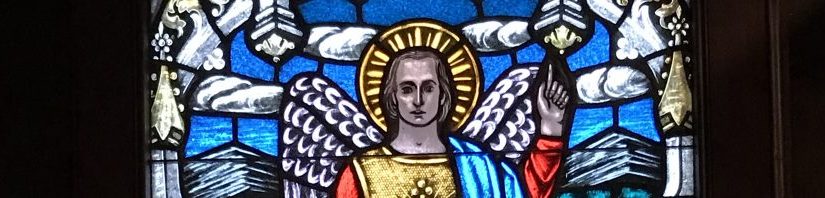
Our reading today from Revelation shows us Michael the Archangel and his phalanx of angels who fight the devil out of heaven.  St. Michael is one of the few archangels mentioned in Scripture, along with Gabriel, the archangel who came to Mary in the Annunciation.  We have both Michael and Gabriel represented in our stained glass windows.

Our insert today says “The Archangel Michael is the powerful angel of God who wards off evil from God’s people, and delivers peace to them at the end of life’s mortal struggle.”

St. Michael the archangel with his mighty sword became a protector for those who suffered and died of AIDS, here in San Francisco and elsewhere.  He was known as the “protector of the defenseless.”

In our garden, we have the Shrine to St. Michael in memory of all those in our parish who died of AIDS.  In Larry Holben’s book on the history of the parish, he includes a description by the artist, which I’m paraphrasing here, “In the void created by the cut-out of the angel, we see where the Archangel was present, has burned through into our space.  This spiritual presence is here to help us.”

That terrible and intense time of the AIDS Crisis is now 30+ years ago. Many of you were today were here, experienced it, and some of you have shared stories with me.  I remember talking with Kenneth about it when I was a student here 14 years ago, and with Sue Singer when I was at CDSP, too.

All Saints’ was a haven for these defenseless young men, like the place Jacob slept, “ a holy place, a house of God, and the gate of heaven.” All Saints’ reached out to them like God reached out to Jacob in his dream, and stood by them until they were taken up Jacob’s ladder to heaven. Our clergy at that time, Kenneth, Judith, and Sue, and the parish, were like angels to them, but they were mortals, not angels.  And there was a cost. I think its traumatic memory is burned into the soul of our parish like the image of St. Michael is burned through the metal in the shrine.

In the last 30 years there’s been research around the impact of trauma on people. Traumatic memories linger and can even be passed down through generations. They can continue to hurt us, and those who come after us long after the traumatic event.

One of the things that came out of our history days was a longing for healing.  I think it’s an important step for us to name it and address it.  Today we will have a Litany of Healing that offers up those traumatic memories, among other wounds of ours to God’s healing grace.

One of the things that I wonder as Interim is: how do we hold this important and tragic episode of our history going into the next phase of All Saints’? What is the role of our Shrine in the garden in the 21st century? 

I don’t know the answer to those questions, but they are important questions for us that I would like to engage more intentionally at a later date.  For one thing, the next Rector will probably in their 40’s which means they were born during the 1970’s or 1980’s. They will have no memory of the AIDS Crisis.  That is something to ponder as we go forward as well.

Today, I dedicate this Mass to those in our parish who died of AIDS, and to those who ministered to them with dedication, love and courage. The list of names of the dead as I have been able to find them will be on the altar as we celebrate the Holy Eucharist. 

Let us remember that we are a people of the Resurrection. When we gather around the altar to make Eucharist together, all our blessed dead are with us in that liminal space between heaven and earth as we break bread together in the Mass. Amen.